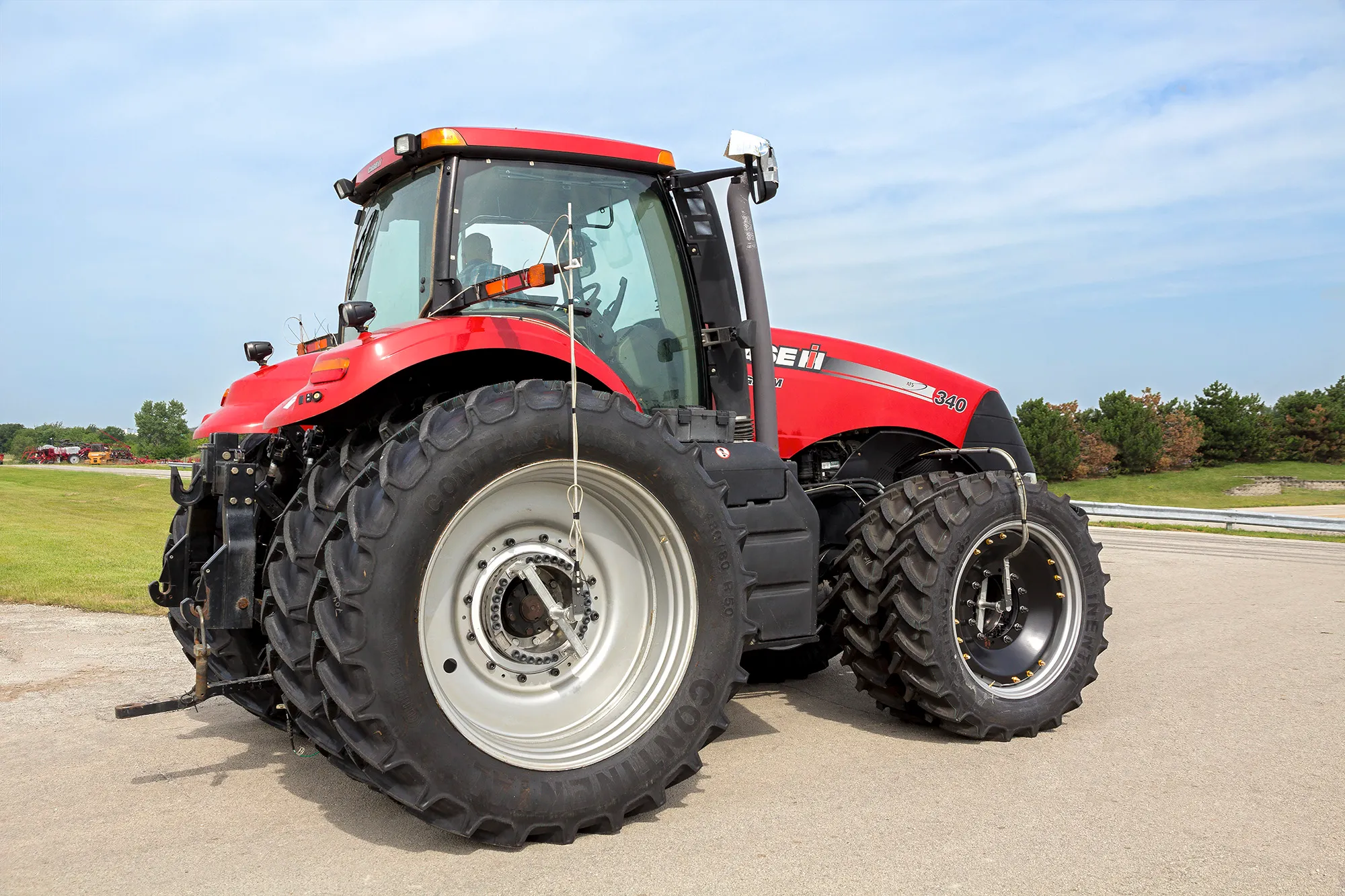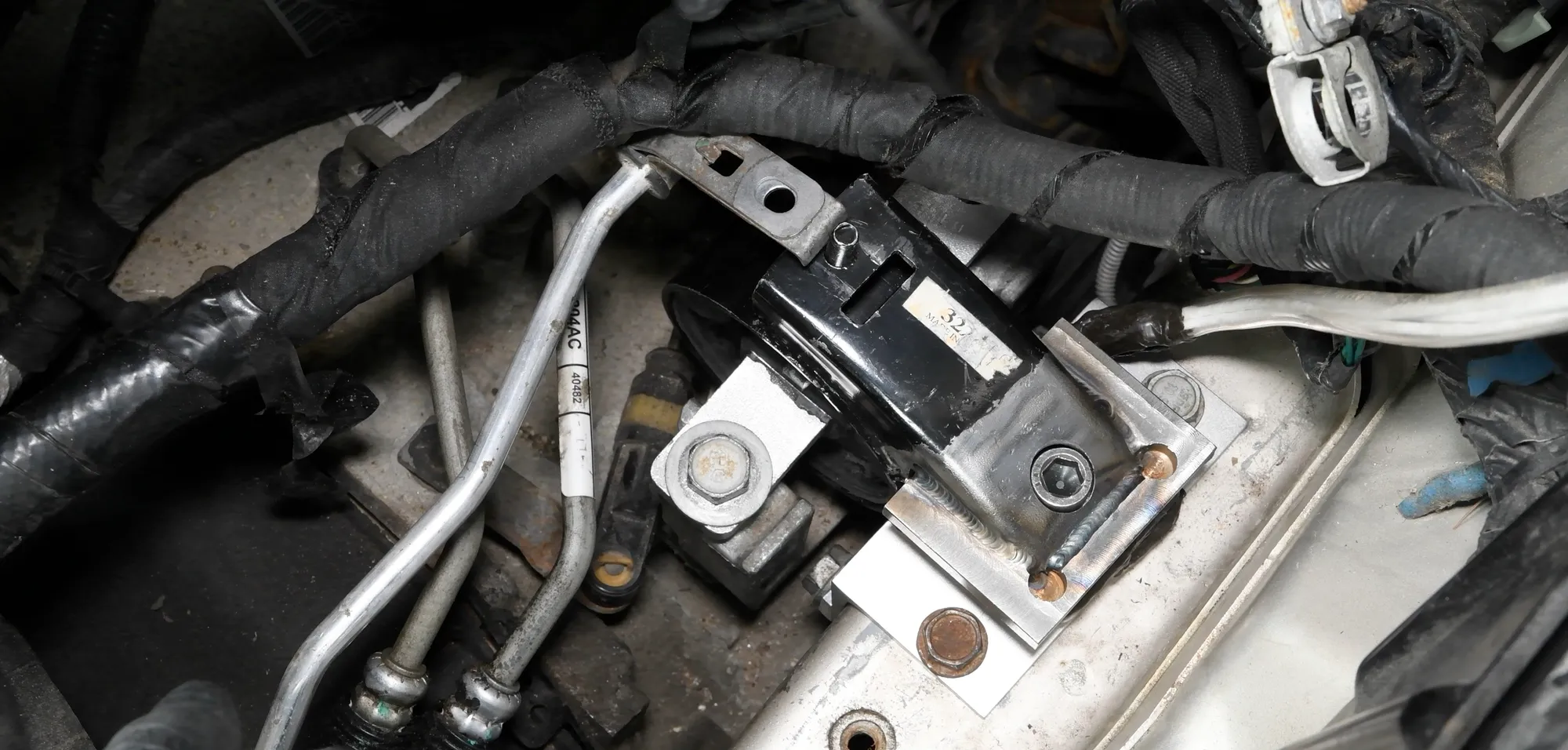
Measuring the three forces at a pintle hitch ring in real towing conditions
In brief
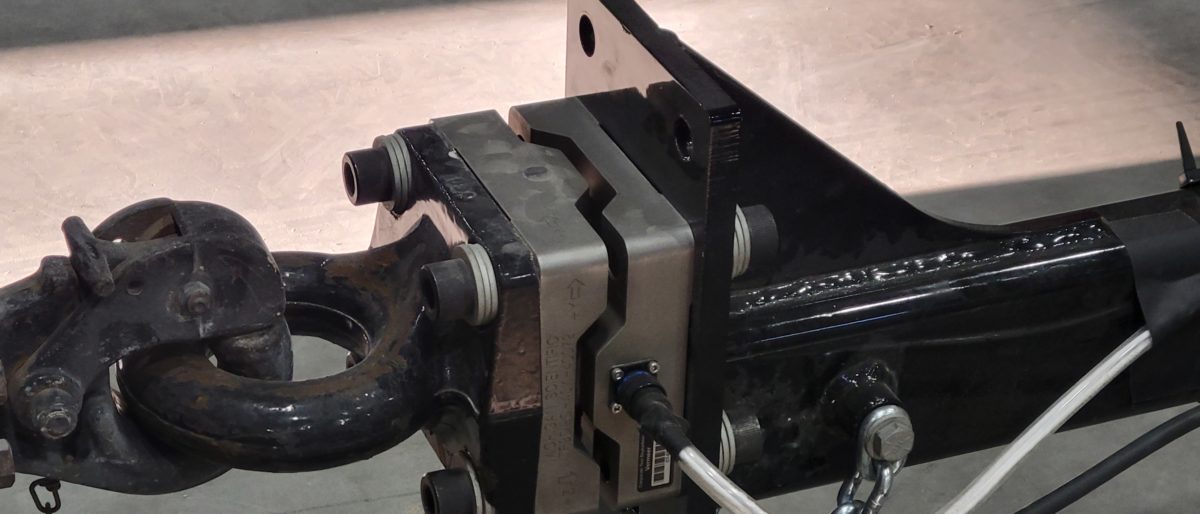
A pintle hitch closes a latch around a ring fixed to the trailer; the ring is trapped but free to pivot. A TR3D-C-40K three-axis load cell is bolted on the trailer behind the ring, so that the longitudinal, lateral and vertical forces between the vehicles pass through it. It measures 177 kN per axis with one strain gage bridge per axis, and its bolt pattern matches some hitch rings directly. An SGA3A amplifier box gives ± 10 V per axis to the recorder.
- 177 kN
- measuring range per axis of the TR3D-C-40K (40 000 lb)
- 9.5 kN·m
- maximum moment per axis
- 3
- orthogonal forces at the ring, one bridge each
Load path
A pintle hitch has a fixed mounting horn, the lower half of a circle, and a latch that forms the upper half. The latch closes around a ring secured to the trailer. The ring is fully trapped but can pivot, which suits heavy-duty towing off road and on all terrain, where a ball mount can become disconnected from its load.
Tongue weight is the vertical force the trailer tongue puts on the hitch. Because the ring and the hitch form a flexible connection, less downward force is put on a pintle hitch than on a ball mount. The test therefore records the vertical force as well as the pull and the lateral force, at the same point, on the vehicle in real towing situations.
Instrumentation
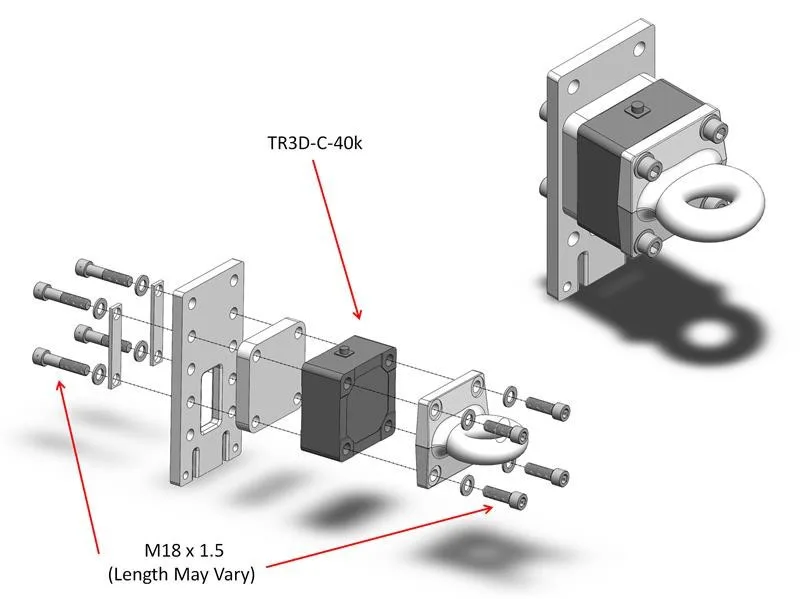
The TR3D-C-40K is the largest TR3D-C model. Its top and base faces have identical mounting surfaces and bolt patterns, so the cell fits between the trailer plate and the ring flange. The same load cell serves for laboratory tests and for field tests on the trailer.
| Load cell | TR3D-C-40K, three orthogonal forces, three four-arm strain gage bridges |
|---|---|
| Measuring range | 177 kN per axis (40 000 lb) |
| Maximum moment | 9 500 N·m per axis |
| Output | 1.5 mV/V |
| Non-linearity | ≤ 1 % FS on X and Y · ≤ 2 % FS on Z |
| Body | 152.4 × 152.4 × 76.2 mm, stainless steel, 7.5 kg, weatherproof sealing, temperature compensated |
| Mounting | 4 × M20 × 2.5 on top and base |
| Cable | 3.05 m, shielded, open-ended leads |
| Usable temperature | −40 to 149 °C |
| Amplifier | SGA3A, bridge excitation ± 5 V or ± 2.5 V, ± 10 V output per axis, remote shunt calibration |
Procedure
- 01
Check the ring bolt pattern
The bolt pattern of the TR3D-C-40K corresponds to some pintle hitch ring bolt patterns; the load cell then bolts on directly. Otherwise an adapter plate is made.
TR3D-C-40K load cell - 02
Mount the load cell on the trailer
Between the trailer plate and the ring flange, behind the pintle hitch ring.
- 03
Condition the three bridges
One SGA3A box excites the three bridges and gives ± 10 V DC per axis to the recorder. With a PS-DC or PS-AC unit, shunt calibration is applied remotely before the run.
SGA3A amplifier box - 04
Tow through the test plan
The three forces are recorded in each towing situation of the plan; the vertical channel gives the tongue weight.
Result
The longitudinal, lateral and vertical forces at the hitch ring, measured in real towing. The vertical channel gives the tongue weight. Where the bolt patterns match, the load cell is installed without an adapter.
Frequent questions
How do you measure tongue weight on a pintle hitch?
With a three-axis load cell bolted on the trailer behind the hitch ring. Its vertical channel gives the tongue weight; the two other channels give the longitudinal and lateral forces at the same point.
Does the load cell need an adapter to fit the hitch ring?
Not always. The bolt pattern of the TR3D-C-40K corresponds to some pintle hitch ring bolt patterns, and the load cell then bolts on directly. The ring is checked against the load cell drawing.
What force range can be measured at the hitch ring?
The TR3D-C-40K measures 177 kN (40 000 lb) per axis in three orthogonal directions, with a maximum moment of 9 500 N·m per axis.
What signal conditioning does the hitch load cell need?
A three-channel strain gage amplifier box such as the SGA3A, which excites the load cell and gives ± 10 V DC per axis to the recorder.