
Application · Speed
Measuring wheel rotation at near-zero speed, forward and reverse
In brief
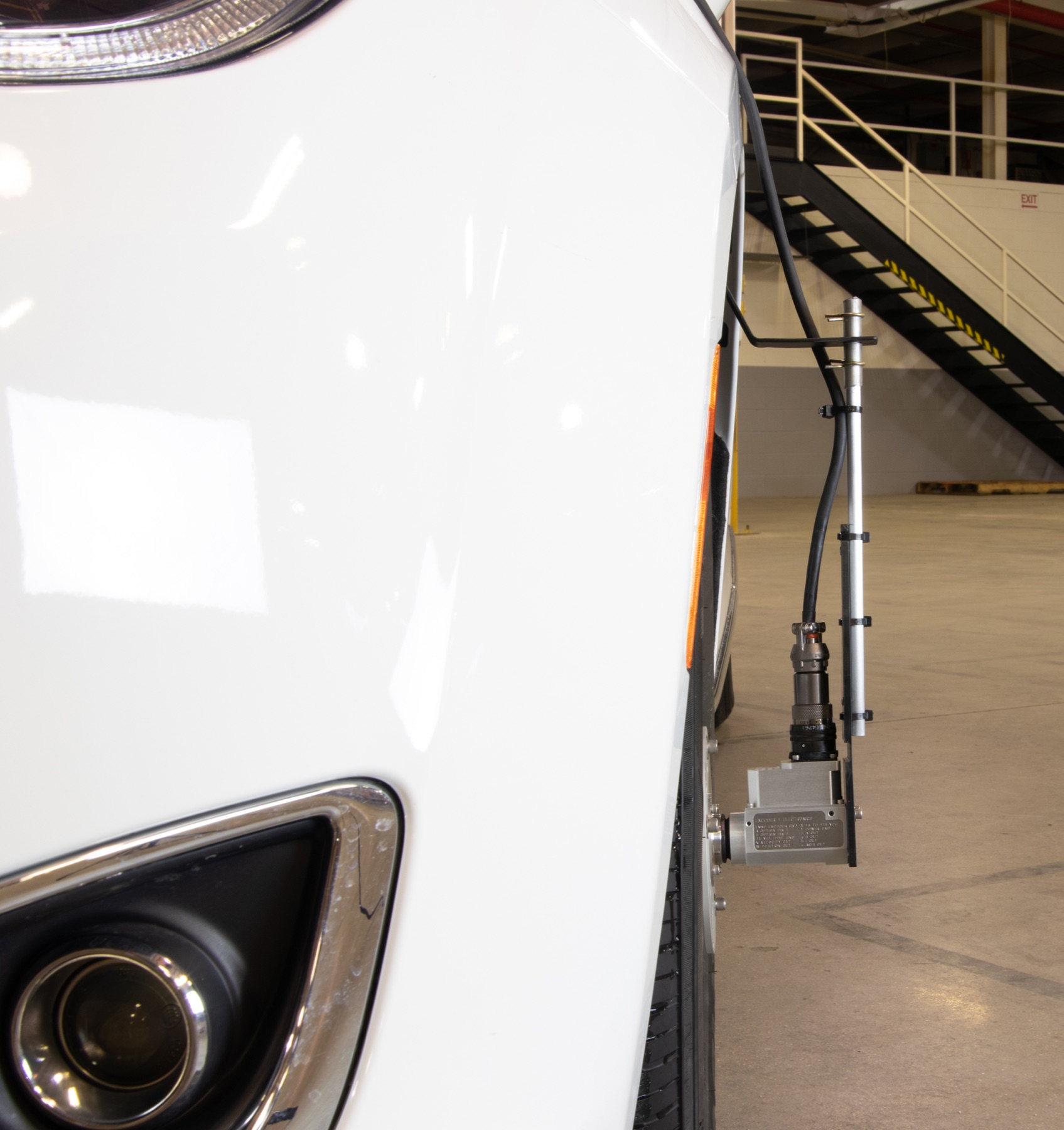
An encoder on a wheel has a stationary part, the stator, that must not turn with the wheel. A rod holds it to the vehicle body. If the rod can move in its holder, the encoder reads that movement as wheel rotation. The Precision Vehicle Stator Restraint (PVSR) keeps the rod centered with a disk brush insert. A case study compared it with the original magnetic restraint in four tests.
- 4
- tests compared: stop and go, hard stop, rollback, wiggle
- 0
- oscillation recorded with the PVSR in the stop and go test
What the restraint does
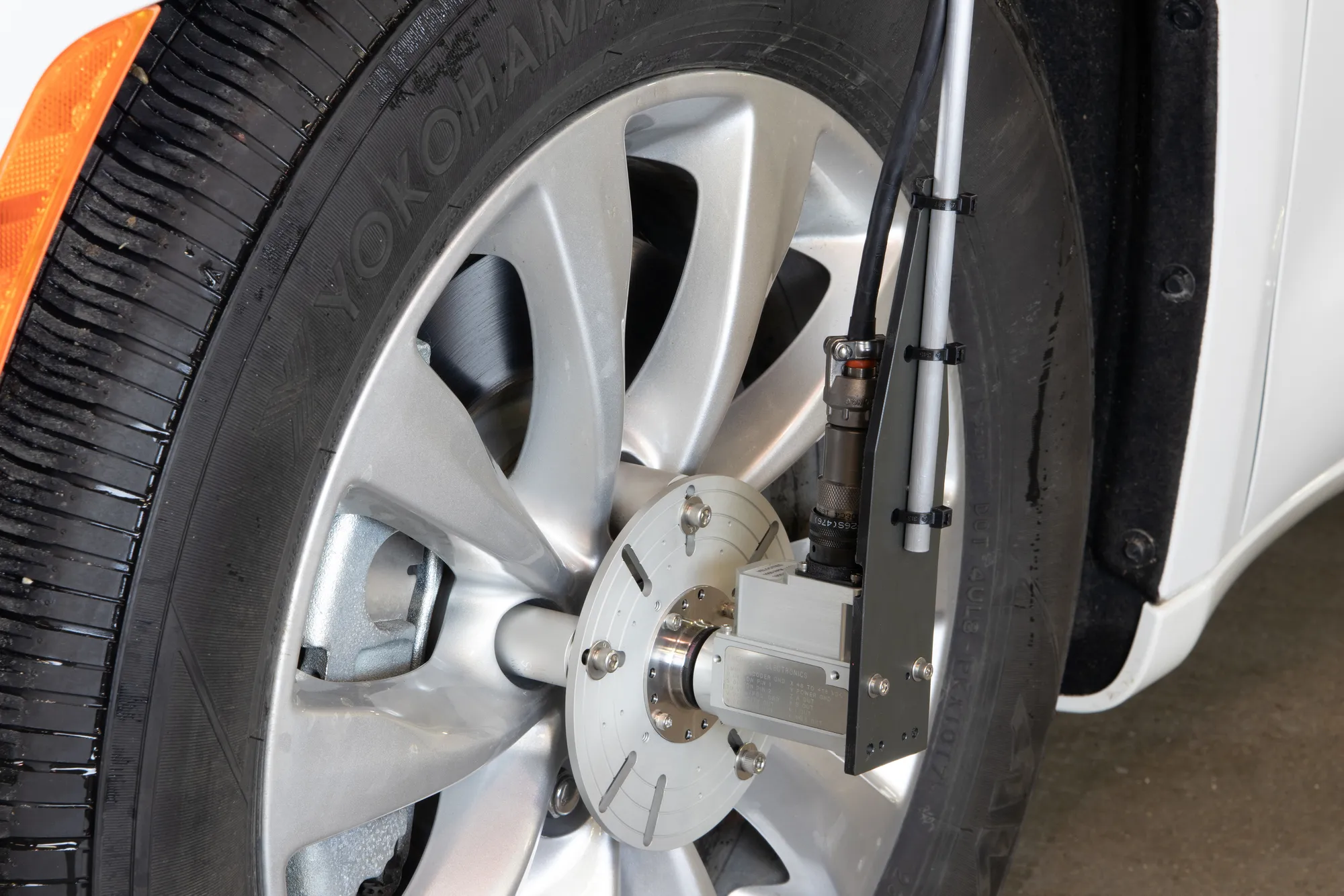
The PVSR attaches to a flat or curved vehicle body: a flexible magnetic sheet holds on the body and carries a holder for the restraining rod. The rod attaches to the stator of a wheel pulse transducer, or of the slip ring in a wheel force or wheel torque transducer assembly.
It is a variation of the Magnetic Vehicle Stator Restraint (MVSR), with a disk brush insert that keeps the rod centered within the holder. It is preferred when wheel rotation is measured at near-zero speed, or when the rotation may change between forward and reverse.
How the two restraints were compared
A wheel pulse transducer was mounted on the rear left wheel of a vehicle, its restraining rod held by the PVSR. Four tests were run, then repeated with the original MVSR, without the disk brush. Video was used to compare the angular motion data with what the wheel actually did.
The results
| Stop and go | PVSR: no oscillation of the rod or the wheel, in the data or on video. Original MVSR: a slight oscillation on stopping and a backward pulse when the brake is released, caused by the rod. |
|---|---|
| Hard stop | Both show the wheel oscillating on stopping. The oscillation recorded with the original MVSR is significantly larger. |
| Rollback | On a ramp, forward then backward. No oscillation with either restraint. |
| Wiggle | The rod is moved by hand. PVSR: no displacement and no noise. Original MVSR: large noise, as nothing holds the rod in place. This could occur on uneven terrain. |
What it shows
At low speed, part of the error on distance and velocity comes from the restraint, not from the encoder. A restraint that keeps the rod centered removed it in the stop and go test, and when the rod was moved by hand as it can be on uneven ground.
Frequent questions
Why does a wheel encoder show a backward pulse when the vehicle stops?
The cause can be the stator restraint, not the wheel. If the restraining rod can move in its holder, the encoder reads that movement as wheel rotation. In the case study, the original magnetic restraint gave a slight oscillation on stopping and a backward pulse when the brake was released.
How is the stator of a wheel encoder held on the vehicle?
A restraining rod attached to the stator is held by a holder on the vehicle body. On the Precision Vehicle Stator Restraint, the holder is carried by a flexible magnetic sheet, and a disk brush insert keeps the rod centered.
Does the stator restraint matter on uneven ground?
Yes. When the rod was moved by hand in the case study, the original magnetic restraint recorded large noise, as nothing held the rod in place. The precision restraint recorded no displacement and no noise.
Can the precision stator restraint be used with a wheel force transducer?
Yes. The restraining rod attaches to the stator of a wheel pulse transducer, or to the stator of the slip ring in a wheel force or wheel torque transducer assembly.
Similar applications
All applications-
 Speed Wheel speed and distance Wheel speed, vehicle speed and distance traveled, read from the rotation of the wheel itself.
 -
 ADAS Autonomous vehicle tracking Distance traveled, measured at the wheels, for dead reckoning and mobile mapping when GNSS is missing.
 -
 Tires Tire-road friction Tire and road surface forces measured in three directions on a traction fixture, to find the coefficient of friction.