
Application · Tires
Measuring tire and road surface forces on a traction test fixture
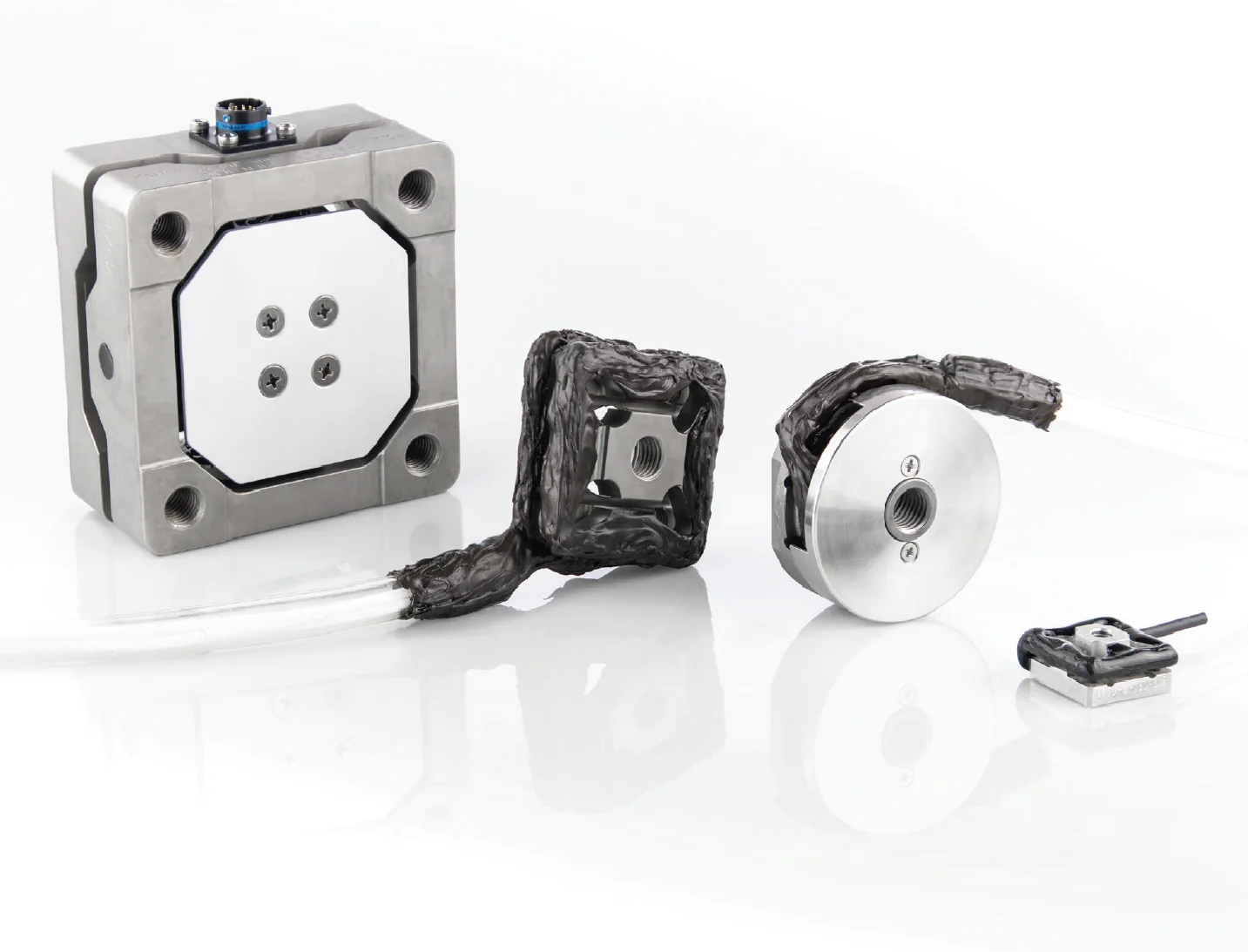
In brief
The coefficient of friction between a tire and a road is the ratio of the force along the surface to the vertical force. On a traction test fixture, a three-axis load cell at the axle measures the forces on the tire, and a second one beneath the test surface measures the forces on the road. Each cell reads three directions at once, so lateral force during simulated cornering is part of the record. The result helps engineers tune wheel slip control for braking and traction systems.
- 3
- force directions measured by each load cell
- 1.1 to 444 kN
- capacity range of the TR3D load cells
- Up to 4
- three-axis load cells on one SGA12A amplifier box
Why the friction between tire and road is measured
Braking, traction control and handling systems all depend on the grip available between the tire and the road. That grip is difficult to measure in vehicle development and testing.
Knowing the conditions that give the maximum coefficient of friction, engineers can tune the wheel slip control more precisely. The same data feeds the development of driver assistance systems.
What a tire formula leaves out
A common way to estimate tire-road friction is the "Magic Formula", which describes tire behavior with four dimensionless coefficients. It does not take camber, turning or lateral motion into account. A direct measurement of the forces, in three directions, covers these cases.
The same contact, measured from both sides
Three-axis load cells can be mounted on both the input side and the reaction side of a traction test. One cell is connected to the axle and measures the forces on the tire. Another is placed beneath the test surface and measures the forces the tire puts on the road.
- 01
A load cell at the axle
Connected to the axle, it measures the three forces applied to the tire.
TR3D three-axis load cells - 02
A load cell under the test surface
Placed beneath the surface, it measures the road surface forces, the reaction side of the test.
- 03
Three directions at once
A single cell measures three axes at the same time, so cornering can be simulated and the lateral force is recorded with the longitudinal and vertical forces.
- 04
Amplify and record
An amplifier box excites and amplifies the bridges of up to four load cells and gives ± 10 V DC outputs to the recorder.
SGA12A amplifier box
From small material samples to tractor tires
TR3D capacities run from 1.1 to 444 kN per axis, and the smallest body measures 25.3 × 25.3 × 12.6 mm, so the cells fit on fixtures with little room. The same method therefore applies to tests on small samples of material and to tests on the tires of construction and agricultural vehicles.
What you get
The three forces on the tire and the three forces on the road surface, measured directly and at the same time. The coefficient of friction comes from these forces, including in cornering, where a formula alone falls short.
Frequent questions
How is the coefficient of friction calculated from the measured forces?
The coefficient of friction between a tire and a road is the ratio of the force along the surface to the vertical force. A three-axis load cell measures these forces at the same time.
Where are the load cells placed on a tire traction test fixture?
One three-axis load cell is connected to the axle and measures the forces on the tire. A second one is placed beneath the test surface and measures the forces the tire puts on the road.
Why measure tire friction directly instead of using the Magic Formula?
The Magic Formula describes tire behavior with four dimensionless coefficients and does not take camber, turning or lateral motion into account. A direct force measurement in three directions covers these cases.
How many three-axis load cells can one amplifier box serve?
Up to four. The SGA12A amplifier box excites and amplifies the bridges of up to four three-axis load cells and gives ± 10 V DC outputs to the recorder.
Similar applications
All applications-
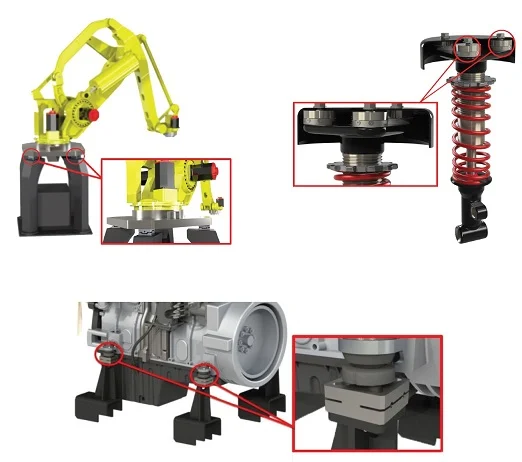 Rig Force and moment load platform Net forces and net moments on a system, calculated from four three-axis load cells.
 -
 Winter Winter testing Wheel forces and wheel speed measured on snow and ice, to see the moment a tire starts to slip.
 -
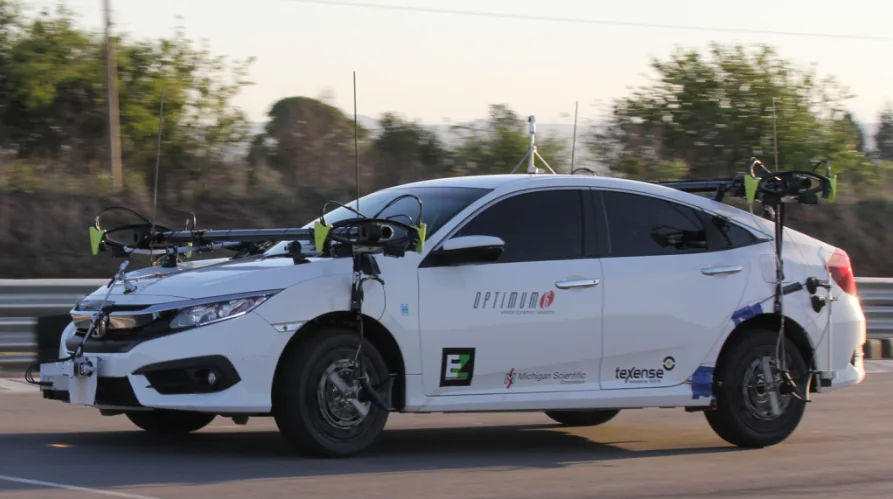 Dynamics Vehicle dynamics The forces and moments at each wheel while the vehicle brakes, turns and changes lane.