
Application · Efficiency
Measuring brake drag and tire rolling drag at the wheel, in normal road driving
In brief
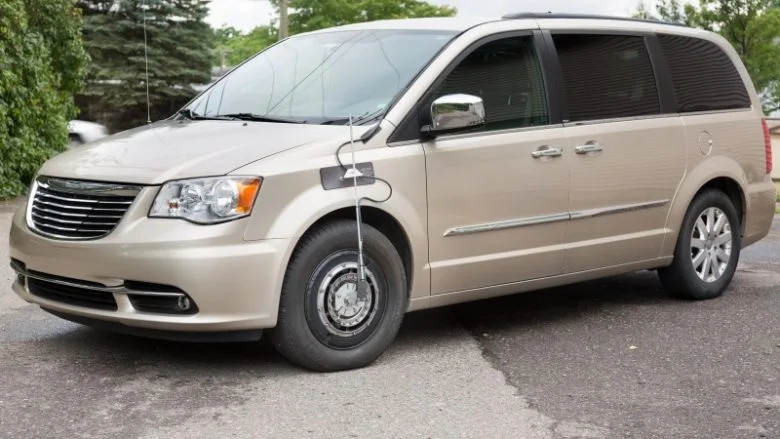
Brake drag and tire rolling resistance are measured on the road with a high-resolution wheel torque transducer mounted in place of the wheel center. It measures the torque between the hub and the tire while the vehicle is driven normally. The drag torques are small, so the resolution of the transducer decides what can be seen. The TW12.8HRMS175, for cars and SUVs, resolves 0.14 N·m. The TWHR2000, for commercial trucks, resolves 1.5 N·m.
- 0.14 N·m
- resolution of the TW12.8HRMS175, cars and SUVs
- 237 N·m
- torque capacity of the TW12.8HRMS175
- 1.5 N·m
- resolution of the TWHR2000, commercial trucks
Chassis losses that do not show in the driveline
Driveline measurements locate the power lost in the transmission and the axle. Other losses sit outside the driveline: aerodynamic drag, tire rolling resistance, brake drag and bearing drag. They also add to fuel consumption.
These chassis losses are measured on the road, at the wheel. The results show where energy is lost in the chassis.
Low torques need a high-resolution transducer
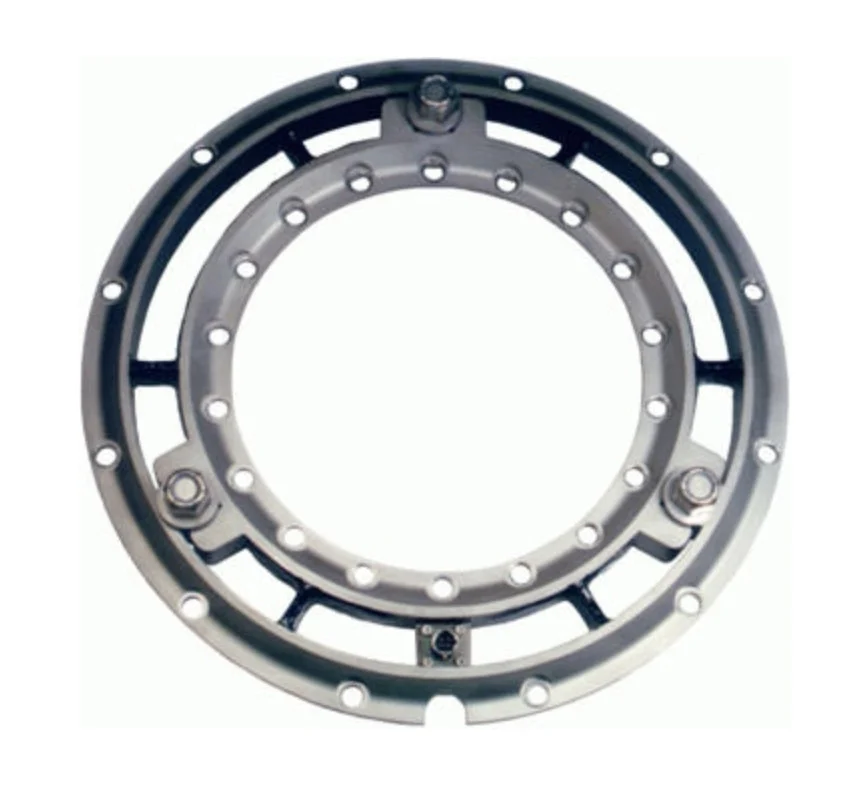
A wheel torque transducer measures the torque about the axle, between the hub and the rim, in both directions. It sees drive torque and brake torque alike.
Drag torques are low compared with drive and brake torques. The high-resolution versions of the TW series give a finer reading of low torques, for work on friction, grip or consumption. The TW12.8HRMS175 has a torque capacity of 237 N·m and resolves 0.14 N·m.
The transducer still carries the wheel. The TW12.8HRMS175 takes a static weight of 1 000 kg and has a mechanical stop capacity of 8.1 kN·m.
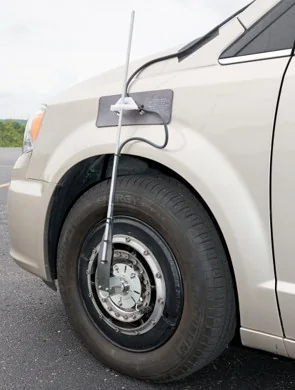
Fitting the transducer on the vehicle's wheel
The transducer is mounted on adapters that duplicate the critical dimensions of the production rim and hub. Michigan Scientific designs and makes these adapters for vehicles from passenger cars to class 8 trucks.
- 01
Choose the model for the vehicle
The TW12.8HRMS175 and the TW12.8HRMS800 are for cars and light-duty vehicles, on rims of 14 in and larger. The TWHR2000 is for trucks, on rims of 22.5 in and larger.
TW series wheel torque transducers - 02
Mount it between the hub adapter and the rim adapter
The transducer takes the place of the wheel center, between a hub adapter and a rim adapter made from the dimensions of the original rim.
- 03
Bring the signal off the wheel
The signal leaves the wheel through a slip ring or by telemetry. A TW transducer needs no interface box.
Slip ring or telemetry - 04
Drive the test on the road
Mechanical overload protection, to 8.1 kN·m on the TW12.8HRMS models and 27 kN·m on the TWHR2000, and IP67 sealing allow the transducer to be used in normal road driving.
Three high-resolution models
The three models differ in torque capacity, resolution and vehicle class. All three are rated IP67 and operate from −40 to 125 °C.
| TW12.8HRMS175 | Cars and light-duty vehicles. Capacity 237 N·m, resolution 0.14 N·m. Rims of 14 in and larger. |
|---|---|
| TW12.8HRMS800 | Cars and light-duty vehicles. Capacity 1 085 N·m, resolution 0.27 N·m. Rims of 14 in and larger. |
| TWHR2000 | Trucks. Capacity 2 700 N·m, resolution 1.5 N·m. Rims of 22.5 in and larger. Static weight up to 5 000 kg. |
What the drag data is used for
On-road measurements of chassis losses are used to work on fuel economy. The same data is used in braking system, vehicle stability and driveline development.
The TWHR2000 is used for the CO2 and fuel consumption tests of Commission Regulation (EU) 2017/2400. Its flyer states that it meets the regulation's requirements for crosstalk, non-linearity, measurement rate and repeatability.
What you get
The low drag torques at the wheel, measured in normal road driving: brake drag, tire rolling drag, bearing seal drag and aerodynamic drag. The resolution is 0.14 N·m on cars and SUVs and 1.5 N·m on commercial trucks.
Frequent questions
What resolution is needed to measure brake drag at the wheel?
The high-resolution wheel torque transducers are made for these low torques. The TW12.8HRMS175 resolves 0.14 N·m on cars and SUVs, the TW12.8HRMS800 resolves 0.27 N·m, and the TWHR2000 resolves 1.5 N·m on commercial trucks.
Can tire rolling resistance be measured on the road instead of on a rig?
Yes. A high-resolution wheel torque transducer measures tire rolling drag in normal on-road driving. Its mechanical overload protection and IP67 sealing allow it to be driven in normal road conditions.
Does a wheel torque transducer fit the production wheel and hub?
It mounts on adapters that duplicate the critical dimensions of the production rim and hub. Michigan Scientific designs and makes these adapters, from passenger cars to class 8 trucks.
Which wheel torque transducer measures small torque variations on a highway truck?
The TWHR2000. It has a torque capacity of 2 700 N·m, fits rims of 22.5 in and larger and resolves 1.5 N·m.
Similar applications
All applications-
 Efficiency Vehicle efficiency and power mapping Torque and speed measured at each driveline stage, from engine to wheel, so each power loss has a location.
 -
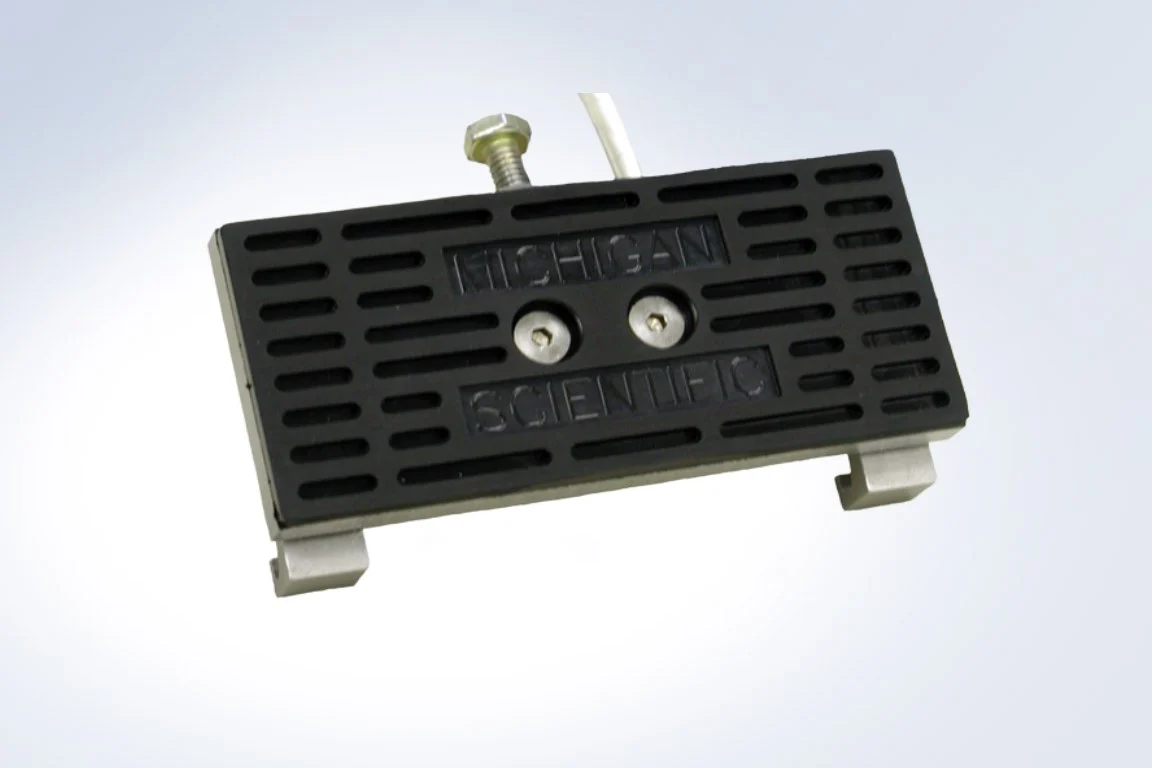 Brakes Brake pedal force The force the driver puts on the brake pedal, read up to 2 200 N on the series pedal.
 -
 Electric EV powertrain torque Torque at each stage of the electric drivetrain, from gearbox shafts to the wheel, to see where power is lost.