
Application · Electric
Measuring torque along an electric drivetrain, from the gearbox to the wheel
In brief
The range of an electric vehicle on one charge depends on the efficiency of its drivetrain. Torque measured at each stage shows how much power is lost between stages. On hybrids, strain gages are applied to the production shafts and the signal leaves through a slip ring or telemetry. With in-wheel motors there is no shaft to gage, so torque is measured at the wheel. On Class 8 trucks, the solid axle is gaged from the inside.
Efficiency decides the range
Range on a single charge comes down to how much of the stored energy reaches the wheels. Every loss between the battery and the tire shortens it, so efficiency is measured all along the drivetrain.
The question is sharpest on a Class 8 electric truck. Charging takes a long time, few charging stations can take a battery of that size, and the truck covers many miles each day. Efficiency can decide whether the vehicle is workable for its buyer.
Rotating parts and electrical noise
Torque is measured on spinning shafts, and the signal has to reach a recorder that does not spin. On a truck with solid axles there is also very little room to mount a slip ring or a transmitter.
An electric vehicle adds a difficulty of its own. Its electrical activity makes a wireless telemetry link harder to shield from noise. Michigan Scientific has developed ways of instrumenting electric vehicles that reduce the effect of this noise.
Torque at each stage of the drivetrain
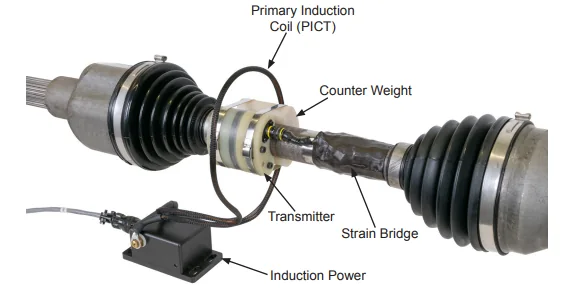
On hybrid and plug-in hybrid vehicles, the electric and combustion units share one drivetrain. Torque measured at each stage is used to calculate the power lost at that stage. The usual method is to apply a strain gage bridge directly to the production shaft or axle, with no custom torque transducer.
- 01
Gage the production shafts
A strain gage bridge is applied to each shaft to be measured. Michigan Scientific has measured torque this way on gearbox input and output shafts, and on the input and output of a damper.
Strain gaging and calibration - 02
Bring the signal off the shaft
A slip ring or a telemetry system connects the spinning bridge to the recorder. Telemetry is powered by a battery on the shaft or by induction. B-Series tubular slip rings slide over propshafts and CV axles, with weatherproof versions and versions with a 60 ppr encoder.
Wireless telemetry systems - 03
Measure the torque at the wheel
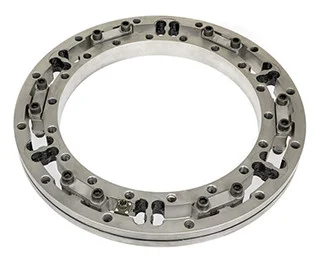
A wheel torque transducer measures drive and brake torque between the tire and the hub.
TW series wheel torque transducers - 04
Compare the stages
Comparing the torque into the axle with the torque measured at the wheel gives the efficiency of what lies between them.
With in-wheel motors, the wheel is the only access
On a battery electric vehicle with in-wheel motors, the wheels are coupled directly to the motors. There is no propshaft and no drive axle to gage. A wheel torque transducer is then the only way to measure torque output.
Independent torque measurements at each wheel also serve the testing of stability control and traction control systems.
Class 8 trucks: gages inside the axle
On Class 8 trucks and other vehicles with solid axles, deep-bore gaging is used. The production axle is drilled through the shaft and strain gages are applied inside the bore. The wires run to a slip ring or a telemetry system mounted outboard of the wheel. An end-of-shaft slip ring can also give wheel speed and position.
The same gaged axles are used in the lab, on a dynamometer. Telemetry suits this case: its digital wireless link has no contact, so it does not wear during long runs. For road tests on highway trucks, the TWHR2000 is a high-resolution wheel torque transducer for rims of 22.5 in and larger: 2 700 N·m capacity, with a non-linearity of 4 N·m (0.15 % FS).
What you get
Torque at the stages you choose, on the production shafts and at the wheel, on the road or on a dynamometer. The difference between stages shows where the drivetrain loses power.
Frequent questions
How is torque measured on a vehicle with in-wheel motors?
With a wheel torque transducer. The wheels are coupled directly to the motors, so there is no propshaft or drive axle to gage, and the wheel is the only place to measure torque output.
How is the efficiency of an electric drivetrain measured on the vehicle?
Torque is measured at each stage of the drivetrain and the stages are compared. Comparing the torque into the axle with the torque at the wheel gives the efficiency of what lies between them.
Does the electrical noise of an electric vehicle affect torque telemetry?
It makes a wireless telemetry link harder to shield from noise. Michigan Scientific has developed ways of instrumenting electric vehicles that reduce the effect of this noise.
How is axle torque measured on an electric Class 8 truck?
By deep-bore gaging. The production solid axle is drilled through the shaft, strain gages are applied inside the bore, and the wires run to a slip ring or a telemetry system mounted outboard of the wheel.
Similar applications
All applications-
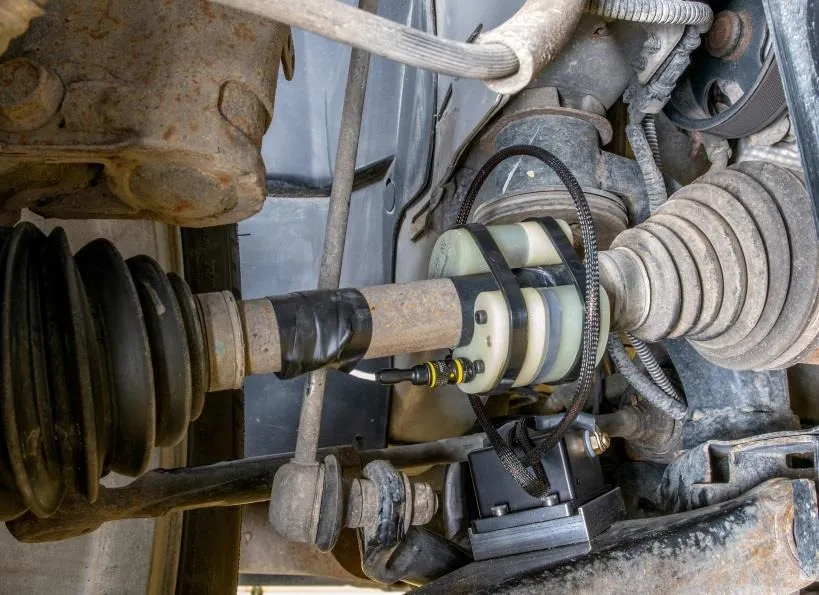 Powertrain Axle and half-shaft torque Drive torque measured on the production shaft, with a slip ring or telemetry to bring the signal out.
 -
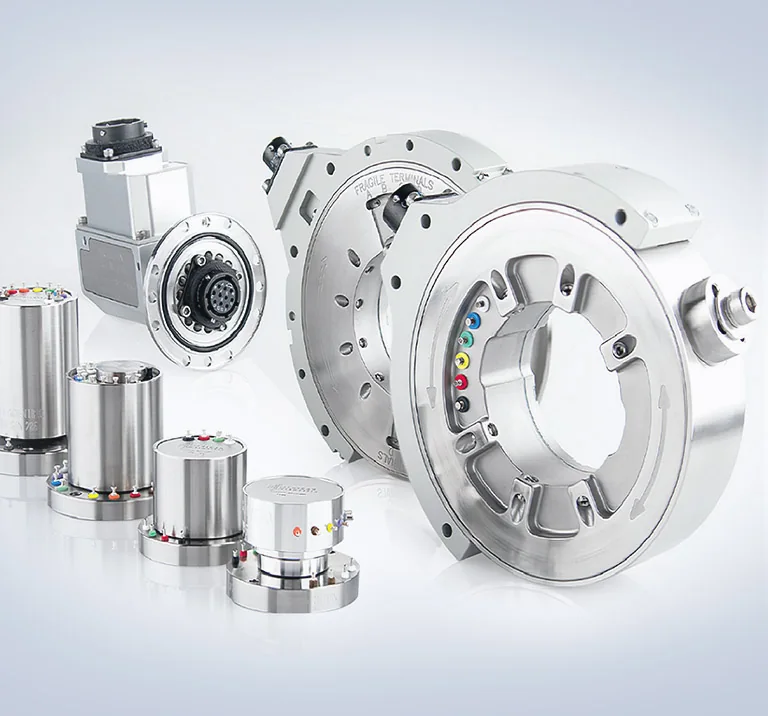 Electric Temperature in electric vehicles Temperatures on the rotating parts of an electric motor, brought out by a slip ring with amplifiers in its rotor.
 -
 Efficiency Vehicle efficiency and power mapping Torque and speed measured at each driveline stage, from engine to wheel, so each power loss has a location.