
Application · Speed
Converting encoder pulses to speed and angle voltages for the data acquisition system
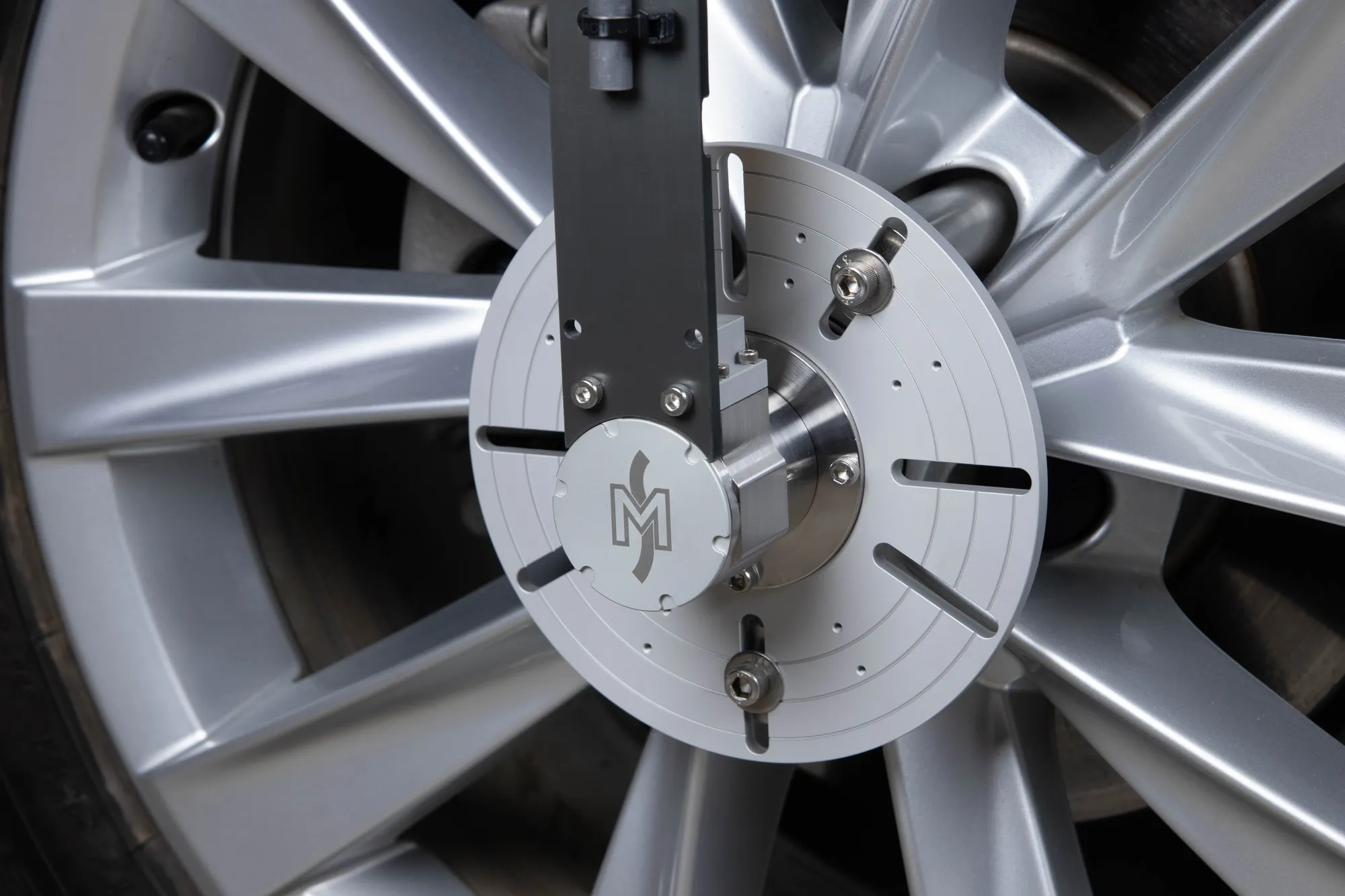
In brief
Encoder pulses are converted to analog voltage with a frequency-to-voltage conditioner placed in line with the encoder cable. The EC-LV reads phase A, phase B and the index pulse and gives two linear voltages: one proportional to angular velocity, one proportional to angular position. It takes its power from the encoder cable. The encoder pulses pass through and stay available to the recorder.
- ± 10 V DC
- speed output, at full-scale velocity
- 0 to 10 V DC
- angle output, for 0 to 360°
- 1 000 or 1 800 rpm
- standard full-scale velocities, selected by a switch
When the recorder cannot read a pulse train
An encoder gives pulses. Some data acquisition systems cannot read high-speed encoder pulse trains and take only analog voltages. Speed and angle then have to reach the recorder as two voltages.
Vehicle testing is one such case. A wheel encoder is used to record wheel speed, vehicle speed and distance traveled, in acceleration tests, braking tests and ABS tests.
Two voltages from three pulse signals
The EC-LV reads phase A, phase B and the index pulse of the encoder. It converts them into two linear voltages. The first is proportional to angular velocity, with ± 10 V DC at full-scale velocity. The second is proportional to angular position, with 0 to 10 V DC for 0 to 360°.
The velocity output updates on the rising edge of phase B for a positive velocity, and on the falling edge for a negative velocity. The position output updates on both edges of phase B. With a 512 pulse per revolution encoder, the velocity updates 512 times per revolution and the position 1 024 times.
The two voltages need no post-processing. The standard encoder outputs A, B, I and A⊕B pass through the conditioner, so the pulse data stays available as well.
Putting the conditioner in the encoder cable
The conditioner is added in line with the encoder cable. It is powered in line with the encoder, so it needs no separate power source and no extra cable.
- 01
Connect it in line with the encoder
The EC-LV goes in the cable of a Wheel Pulse Transducer or of a slip ring with a built-in encoder. Its input voltage is 5 to 20 V DC.
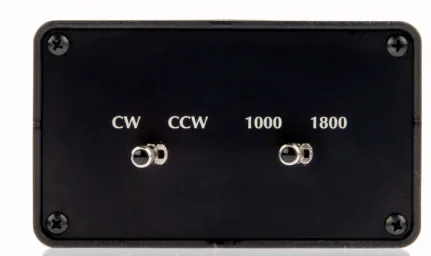
EC-LV encoder conditioner - 02
Select the full-scale velocity
A toggle switch selects one of two values set at the factory. The standard values are 1 000 and 1 800 rpm. Full-scale velocity equals ± 10 V DC.
- 03
Select the positive direction
A second toggle switch selects which direction of rotation, clockwise or counter-clockwise, gives a positive output.
- 04
Record the two voltages
The velocity and position voltages go to analog inputs of the data acquisition system. The encoder pulses can be recorded as well, where the system reads them.
Scaling, supply and housing
The full-scale velocity is set at the factory. Custom values can be requested, and so can a custom full-scale voltage for systems that cannot take 10 V DC inputs.
| Speed output | ± 10 V DC at full-scale velocity |
|---|---|
| Angle output | 0 to 10 V DC for 0 to 360° |
| Full-scale velocity | 1 000 or 1 800 rpm as standard, by toggle switch |
| Encoder outputs passed through | A, B, I, A⊕B |
| Input voltage | 5 to 20 V DC |
| Operating temperature | −40 to 100 °C |
| Dimensions | 142 × 94 × 56 mm |
| Housing | Aluminum, IP40 |
Which encoders it is used with
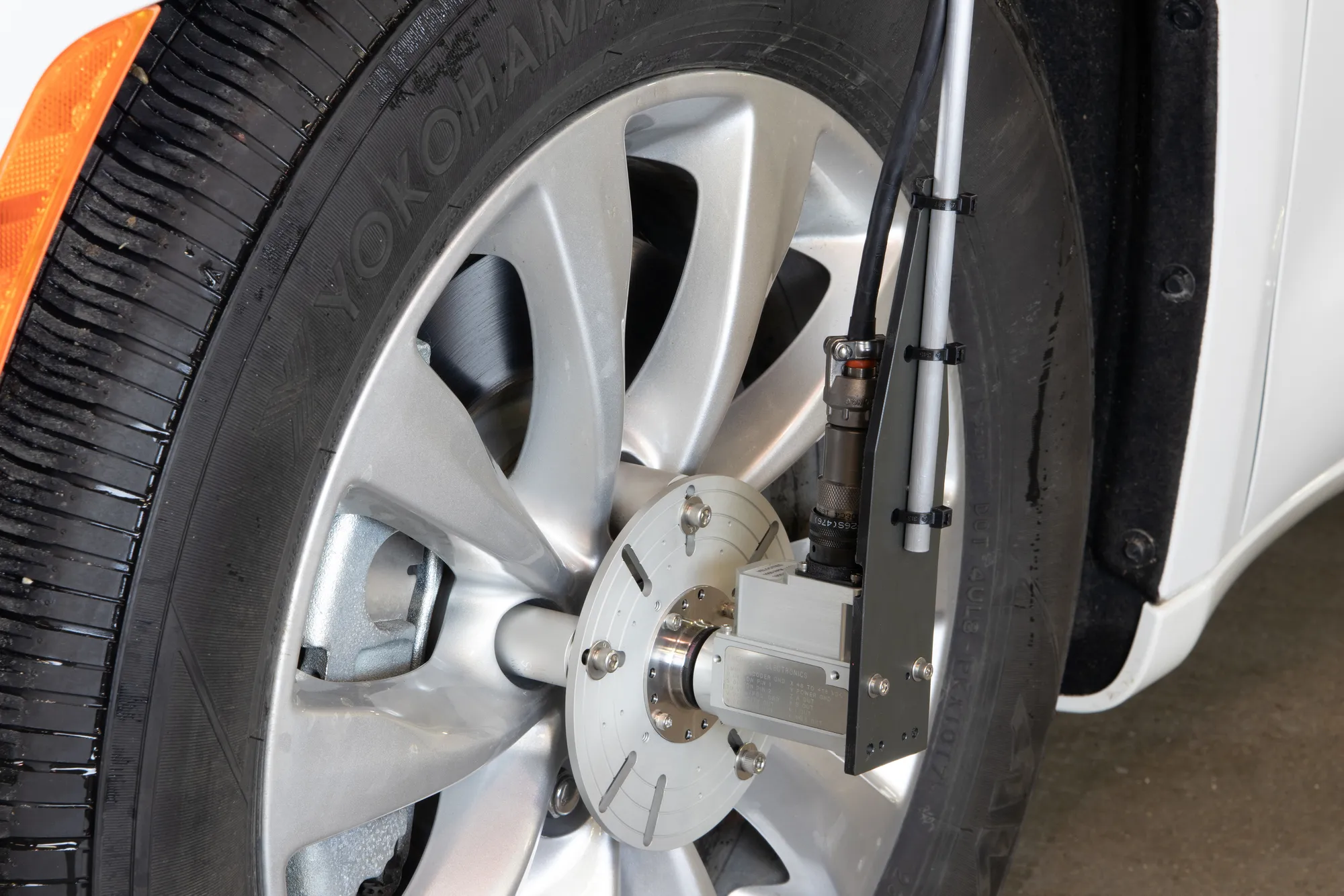
The Wheel Pulse Transducer is an optical encoder mounted outboard of the wheel, ordered from 50 to 5 000 pulses per revolution. It has four 0 to 5 V outputs that can drive TTL loads: A and B in quadrature, an index pulse I, and A⊕B. The two are commonly used together in automotive testing, to gather wheel speed, vehicle speed and distance traveled.
The frequency-to-voltage electronics sit in the conditioner, not in the encoder, so the Wheel Pulse Transducer keeps a small profile on the wheel.
The conditioner is also used with a slip ring that has a built-in encoder. The SR/PE512 Series has a 512 pulse per revolution quadrature encoder with index, and the SR/E60 Series a 60 pulse per revolution encoder. Both give analog signals with Michigan Scientific frequency-to-voltage encoder electronics.
What you get
Speed and angle as two analog voltages that any recorder with analog inputs can take, with no post-processing and no extra supply. The encoder pulses stay available on the same cable for the systems that read them.
Frequent questions
Does a frequency-to-voltage encoder conditioner need its own power supply?
No. The EC-LV is powered in line with the encoder cable, so it needs no separate power source or cable. Its input voltage is 5 to 20 V DC.
Are the encoder pulses still available after the conversion?
Yes. The encoder outputs A, B, I and A⊕B pass through the EC-LV and remain available next to the two analog voltages.
How often does the analog speed output update?
Once per pulse of phase B. With a 512 pulse per revolution encoder, the velocity output updates 512 times per revolution, and the position output 1 024 times because it uses both edges.
Can the voltage scale of the speed output be changed?
Yes. Two full-scale velocities are set at the factory, 1 000 and 1 800 rpm as standard, and selected with a toggle switch. Custom full-scale velocities and a custom full-scale voltage can be requested.
Similar applications
All applications-
 Speed Wheel speed and distance Wheel speed, vehicle speed and distance traveled, read from the rotation of the wheel itself.
 -
 ADAS Autonomous vehicle tracking Distance traveled, measured at the wheels, for dead reckoning and mobile mapping when GNSS is missing.
 -
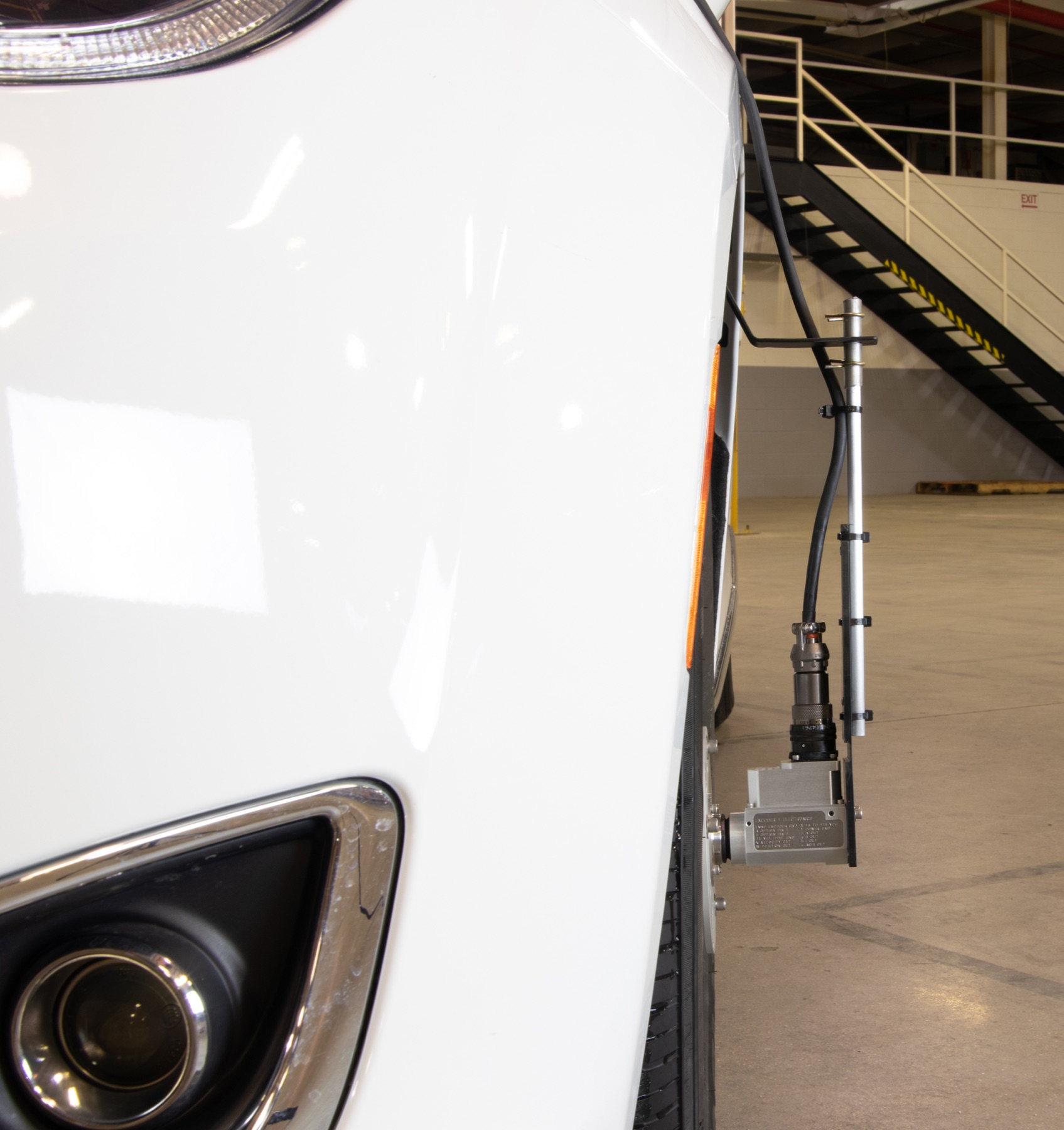 Speed Low-speed wheel rotation Distance and speed at near-zero speed and through a change of direction, without the error a loose stator restraint adds.