
Application · Electric
Measuring drive and brake torque at each wheel of a vehicle with in-wheel motors
In brief
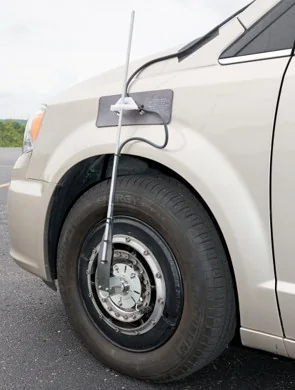
On a battery electric vehicle with in-wheel motors, torque is measured with a wheel torque transducer. The wheels are coupled directly to the drive motors, so there is no propshaft and no drive axle to fit with strain gages. The transducer measures the driving and the braking torque between the tire and the hub. Independent measurements at each wheel are used to test the stability control and traction control systems.
- 237 N·m to 81 kN·m
- torque capacity, TW series
- 24 to 121 °C
- temperature-compensated calibration, TW series
- IP67
- protection, high-resolution TW models
No shaft between the motor and the wheel
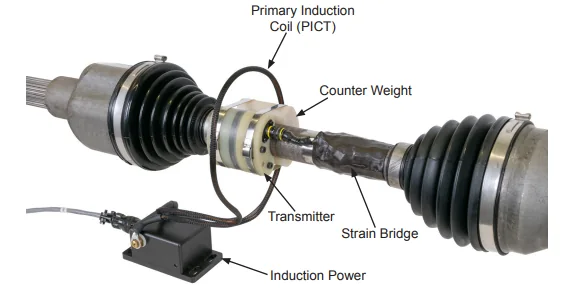
The most common way to measure drive torque is to apply a strain gage bridge to the production shaft or axle, and to bring the signal out through a slip ring or by telemetry.
A battery electric vehicle with in-wheel motors has no such shaft. The wheels are coupled directly to the drive motors, with no propshaft and no drive axle. The torque output is measured at the wheel instead, with a wheel torque transducer.
Torque between the tire and the hub
A wheel torque transducer measures the driving and the braking torque between the tire and the hub of the wheel. It reads My, the torque about the wheel axis, in both directions.
The calibration is temperature compensated between 24 and 121 °C, so the heat that repeated braking puts into the hub does not move the reading.
Each wheel is measured independently. These measurements are used to test the stability control and the traction control systems of battery electric vehicles.
Fitting the transducer on the wheel
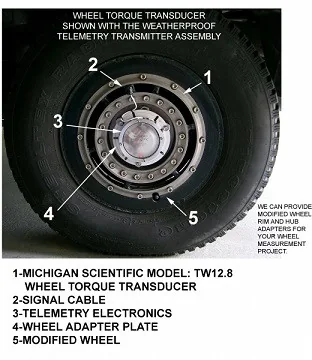
The transducer takes the place of the wheel center. It mounts between a hub adapter and a rim adapter that reproduce the dimensions of the original rim.
- 01
Choose the model for the torque and the rim
The TW series covers torque capacities from 237 N·m to 81 kN·m. The minimum rim size depends on the model.
TW series wheel torque transducers - 02
Mount it with the hub and rim adapters
The adapters are designed from the profile of the original rim.
- 03
Bring the signal off the wheel
The signal leaves the wheel through a slip ring or by telemetry. A slip ring is wired and has an encoder option. Telemetry leaves no cable through the hub.
- 04
Record one channel per wheel
A transducer on each driven wheel gives an independent torque measurement for that wheel.
Other signals at the wheel, and all six load components
The Wheel Instrumentation System is a slip ring that bolts to the vehicle's own wheel. It carries up to 30 strain gage and thermocouple signals off the rotating wheel in analog form, with no pre-amplifier stage, and can be used on electric vehicles with the motor at the wheel.
Electric drivetrains let the wheels spin at different rates or in different directions. Torque vectoring and skid steering then have to be tested. When the forces and the moments at each wheel are needed, and not only the torque, a wheel force transducer is used.
What you get
The driving and the braking torque at each wheel of a vehicle with in-wheel motors, measured between the tire and the hub. It is the torque output of the vehicle, taken where no shaft can be gaged.
Frequent questions
Why can torque not be measured on a shaft with in-wheel motors?
There is no shaft to measure on. The wheels are coupled directly to the drive motors, so the vehicle has no propshaft and no drive axle to fit with strain gages.
Does a wheel torque transducer measure braking torque as well as drive torque?
Yes. A wheel torque transducer measures both the driving and the braking torque between the tire and the hub of the wheel.
What is torque at each wheel used for on an electric vehicle?
Independent torque measurements at each wheel are used to test the stability control and the traction control systems of battery electric vehicles.
Similar applications
All applications-
 Electric EV powertrain torque Torque at each stage of the electric drivetrain, from gearbox shafts to the wheel, to see where power is lost.
 -
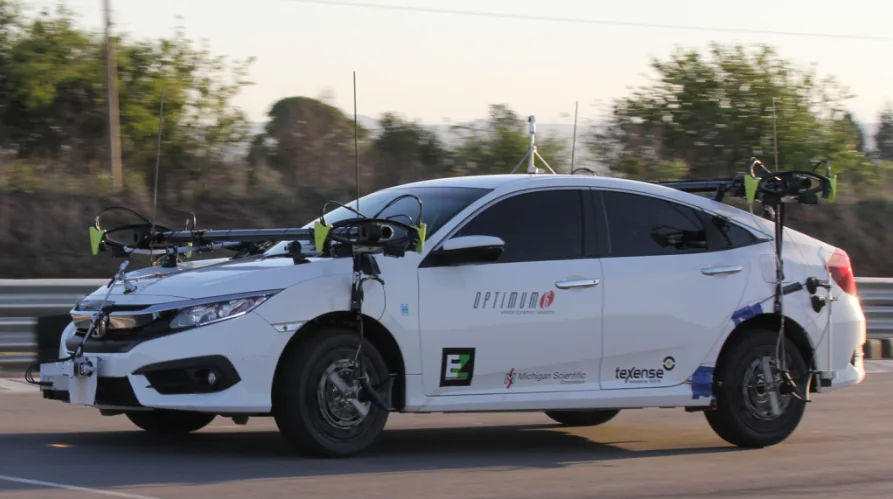 Dynamics Vehicle dynamics The forces and moments at each wheel while the vehicle brakes, turns and changes lane.
 -
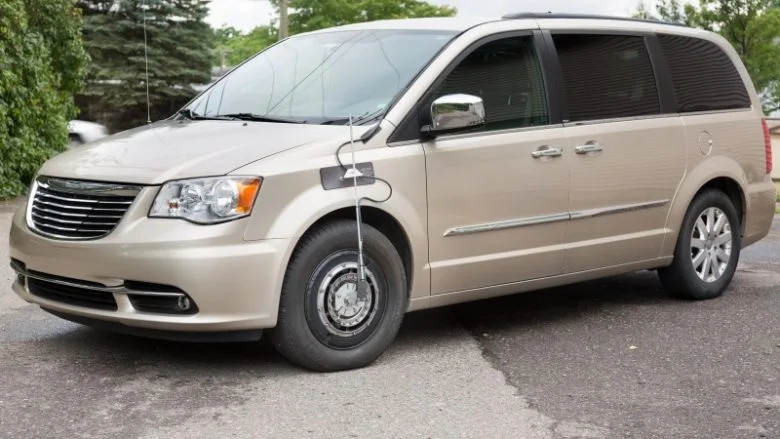 Efficiency Brake drag and rolling resistance Low drag torques at the wheel, read on the road with a resolution of 0.14 N·m on cars and SUVs.