
Application · Steering
Measuring steering torque and angle at the handlebar of a motorcycle
In brief
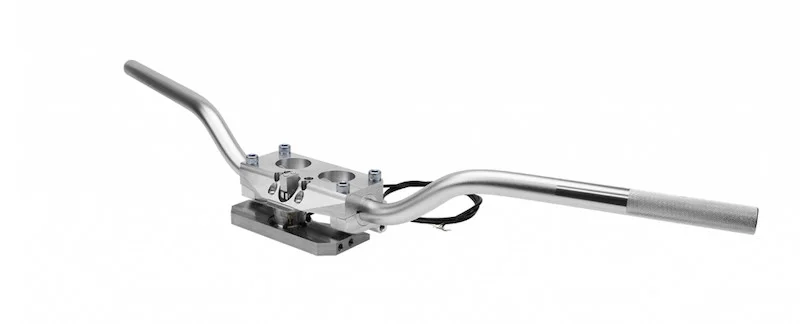
Steering torque on a motorcycle is measured with a transducer mounted on the handlebar, in place of the handlebar clamps. The Model HBT measures torque with a strain gage sensor up to 135 N·m, and steering angle with an inductive encoder over ± 180°. The handlebars keep working normally. Torque and angle are output as ± 10 V and on CAN 2.0.
- ± 135 N·m
- torque range
- ± 180°
- steering angle range
- 1.6 kg
- weight of the transducer assembly
What is measured at the handlebar
The transducer measures the torque the rider applies to the handlebar, the steering effort, and the steering angle at the same time. Steering rate is also available, on CAN only.
The transducer takes the place of the handlebar clamps
The HBT mounts on the steering handlebars of a motorcycle, or on the steering shaft of an ATV. It replaces the existing handlebar clamps or mounts to them. The original operation of the handlebars is not altered.
The mounting is adapted to each motorcycle. Michigan Scientific can design and make a mounting system for the vehicle.
Torque is measured by a full-bridge strain gage sensor in high strength stainless steel, temperature compensated. Steering angle comes from a high-resolution inductive encoder.
Fitting the transducer and recording the signals
The system comes with the sensor, the encoder, the mounting brackets and the signal conditioning electronics.
- 01
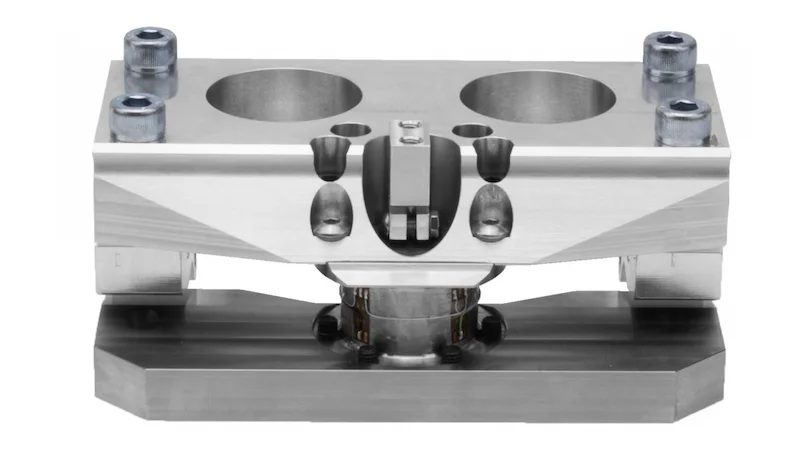
Replace the handlebar clamps
The transducer replaces the existing handlebar clamps, or mounts to them.
Model HBT handlebar torque and angle transducer - 02
Fix the encoder restraint
The anti-rotation restraint of the encoder is fixed to a stationary point on the motorcycle.
- 03
Connect the control unit
A DIGI-STEER control unit powers both sensors from a supply of 9 to 36 V DC. It has the zeroing and shunt calibration controls.
- 04
Record torque and angle
Torque and angle come out as ± 10 V and on CAN 2.0. Steering rate is on CAN only.
Ranges, outputs and environment
The rated torque capacity is 135 N·m. Ranges below 135 N·m are possible. Counter-clockwise torque gives a positive output.
| Rated torque capacity | 135 N·m |
|---|---|
| Safe axial load | 440 N |
| Torque non-linearity | < 1 % of full scale output |
| Steering angle range | ± 180° |
| Angle accuracy | ± 0.3° |
| Maximum speed for angle measurement | 333 rpm |
| Signal outputs | ± 10 V and CAN 2.0 |
| CAN bit rate | 1 Mbit/s |
| Input power | 9 to 36 V DC |
| Compensated temperature range | −12 to 49 °C |
| Operating temperature range | −20 to 80 °C |
| Protection class | IP65 |
| Weight, transducer assembly | 1.6 kg |
Wheel forces on the same motorcycle
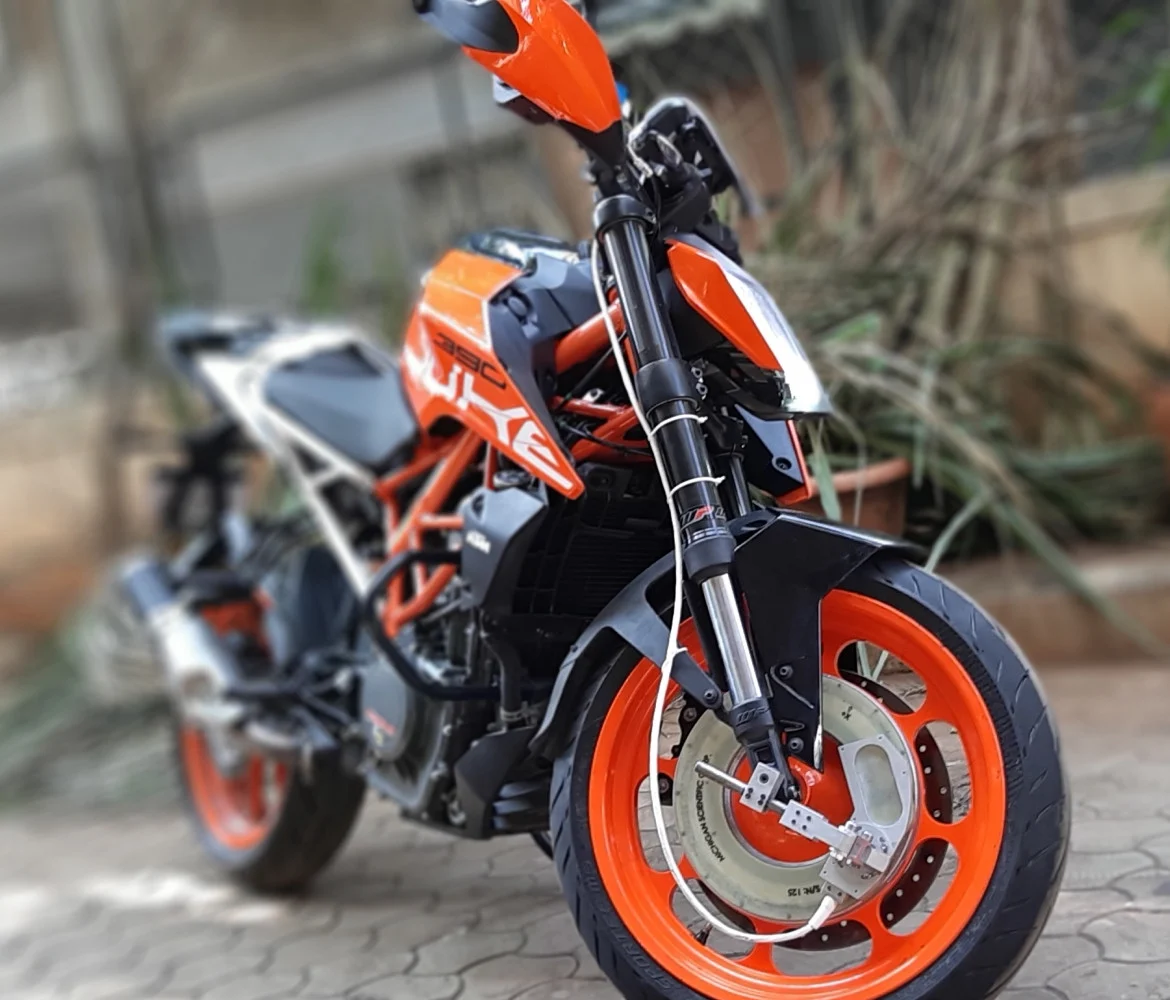
The handlebar gives the input of the rider. The forces at the wheel are measured with a wheel force transducer, which gives three forces and three moments at the wheel center, with wheel speed and angle.
The LW-MC-3.5K is the model of the LW series for motorcycles. Its capacity is 15.5 kN on Fx and Fz and 5.3 kN on Fy.
What you get
The torque at the handlebar up to 135 N·m and the steering angle over ± 180°, recorded together on the motorcycle or the ATV, as analog signals and on CAN 2.0. The handlebars work as usual during the test.
Frequent questions
Does a handlebar torque transducer change how the motorcycle steers?
The handlebars keep working normally. The Model HBT replaces the existing handlebar clamps or mounts to them, and does not alter the original operation of the handlebars.
What torque range does a motorcycle steering torque sensor cover?
The Model HBT has a rated torque capacity of 135 N·m, with a non-linearity below 1 % of full scale output. Ranges below 135 N·m are possible.
Can steering angle be measured with the steering torque on a motorcycle?
Yes. The Model HBT measures both at the same time. An inductive encoder gives the steering angle over ± 180°, and steering rate is available on CAN.
Can the same transducer be used on an ATV?
Yes. The Model HBT mounts on the steering handlebars of a motorcycle or on the steering shaft of an ATV.
Similar applications
All applications-
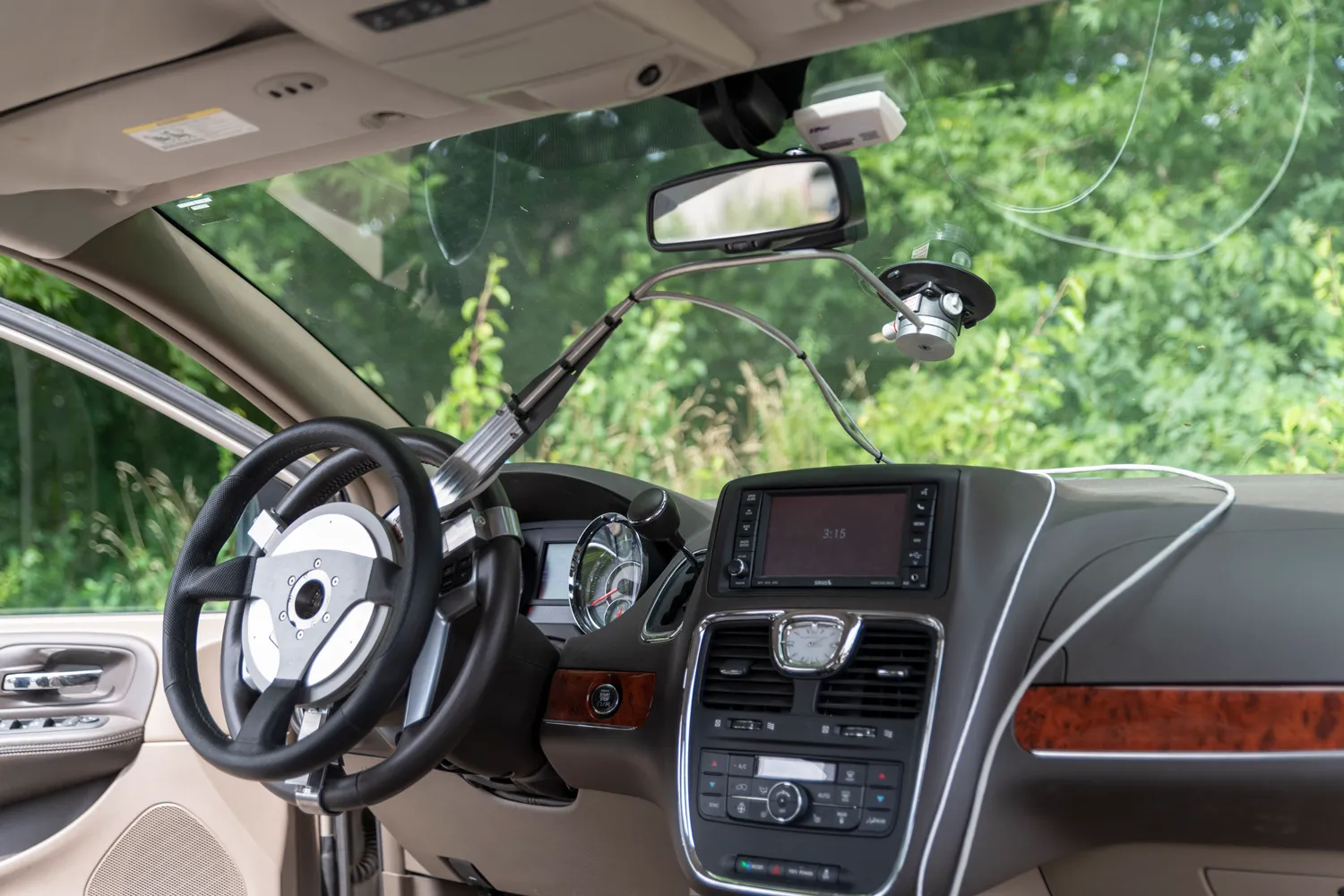 Steering Steering torque and angle The torque the driver applies and the angle of the wheel, measured at the steering wheel, on the road or in the laboratory.
 -
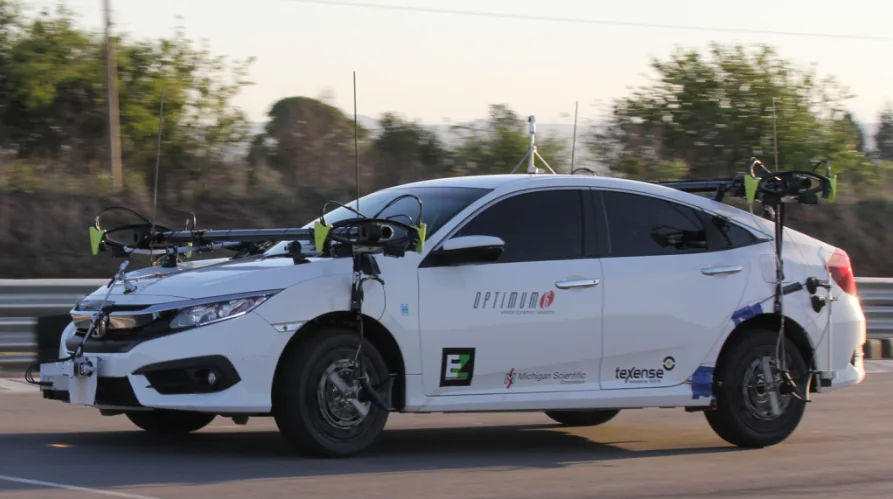 Dynamics Vehicle dynamics The forces and moments at each wheel while the vehicle brakes, turns and changes lane.
 -
 Durability Wheel loads on the road Three forces and three moments at each wheel, recorded while the vehicle is driven.