
Application · Durability
Keeping the instrumented wheel close to the mass of the production wheel
In brief
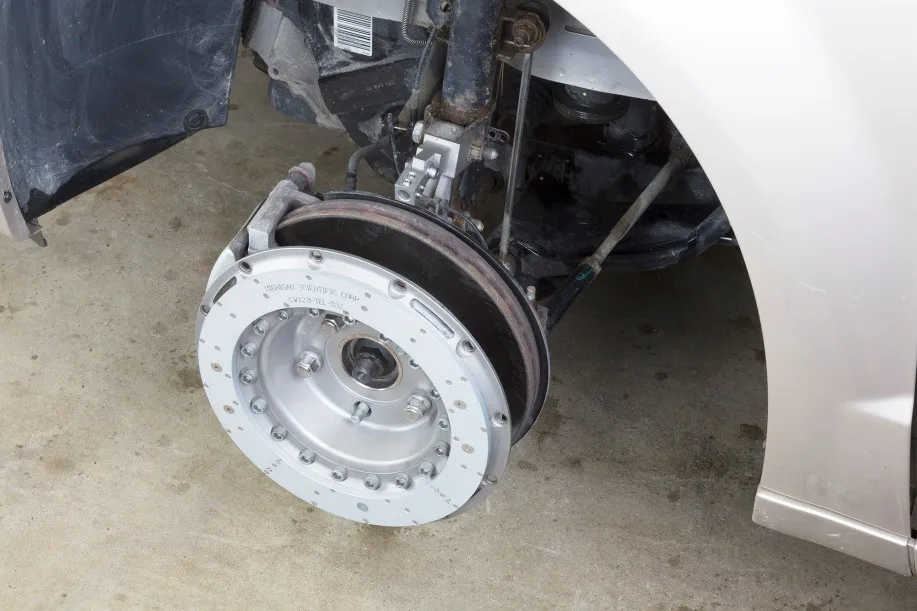
During a durability test, the wheel force transducer assembly replaces the production wheel: transducer, signal conditioning electronics, rim adapter and hub adapter. Its mass influences the measurement: the closer it is to the mass of the production wheel, the more representative the input loads. Weight-optimized adapters reduce the gap.
- SAE J328
- fatigue testing that validates the adapter simulations
- Aluminum forging
- material of the lightweight rim adapter
- Titanium
- material of the lightweight hub adapter
Why the mass matters
Measuring road input loads with wheel force transducers is standard practice in durability testing. If the assembly is significantly heavier than the production wheel, the test may generate lower peak loads than the same test run with lighter wheels.
A transducer in the right range, and lighter adapters
The transducer is one part of the mass: the LW12.8-50, rated 50 kN radial, weighs 4.7 kg. The adapters are the other main contributor. To get close to the mass of the original wheel, choose a transducer of the appropriate range and weight-optimized adapters.
| Rim adapter | Machined from an aluminum forging. A standard rim adapter is a modified, welded production rim. |
|---|---|
| Hub adapter | Machined from titanium. A standard hub adapter is made of high-strength stainless steel. |
Designed for the vehicle, not for the transducer
The design optimization is included in the purchase of reduced-mass adapters, and done for each application. The adapters are designed on the maximum static load of the vehicle rather than on the maximum capacity of the transducer: the lighter the vehicle, the more mass can be removed.
The engineers use computer simulation results validated with SAE J328 fatigue testing, so that the adapters withstand durability testing with as little mass as possible.
- 01
Vehicle data
Maximum static load, wheel dimensions, hub interface.
- 02
Design
Lightweight or one-piece rim and hub adapters, optimized for that load.
- 03
Validation
Simulation, validated with SAE J328 fatigue testing.
- 04
Manufacture
Aluminum forging for the rim adapter, titanium for the hub adapter.
What you get
An instrumented wheel whose mass is close to that of the production wheel, and road load data whose peaks are not lowered by the instrumentation.
Frequent questions
Does the weight of a wheel force transducer affect the measured loads?
Yes. If the assembly is significantly heavier than the production wheel, the test may generate lower peak loads than the same test run with lighter wheels.
What are lightweight wheel force transducer adapters made of?
The lightweight rim adapter is machined from an aluminum forging and the lightweight hub adapter from titanium. A standard rim adapter is a modified, welded production rim, and a standard hub adapter is high-strength stainless steel.
How are reduced-mass wheel force transducer adapters validated?
The adapters are designed with computer simulation results that are validated with SAE J328 fatigue testing, so they withstand durability testing with as little mass as possible.
Why does a lighter vehicle allow lighter adapters?
Reduced-mass adapters are designed on the maximum static load of the vehicle, not on the maximum capacity of the transducer. The lighter the vehicle, the more mass can be removed.
Similar applications
All applications-
 Durability Wheel loads on the road Three forces and three moments at each wheel, recorded while the vehicle is driven.
 -
 Durability Durability campaigns The load each wheel really sees on a pothole, an obstacle or a rough track, as recorded data.
 -
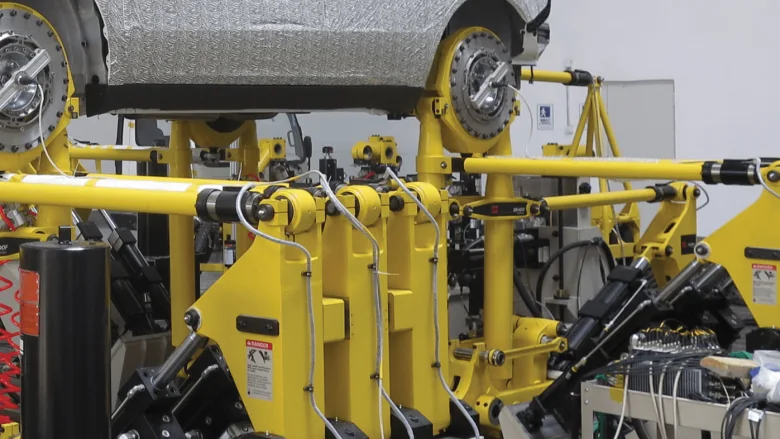 Test rig Road simulators The loads measured at the wheel on the road, and the proof that the simulator reproduces them.