
Application · Temperature
Measuring brake disc and hub temperature on a turning wheel, on the road
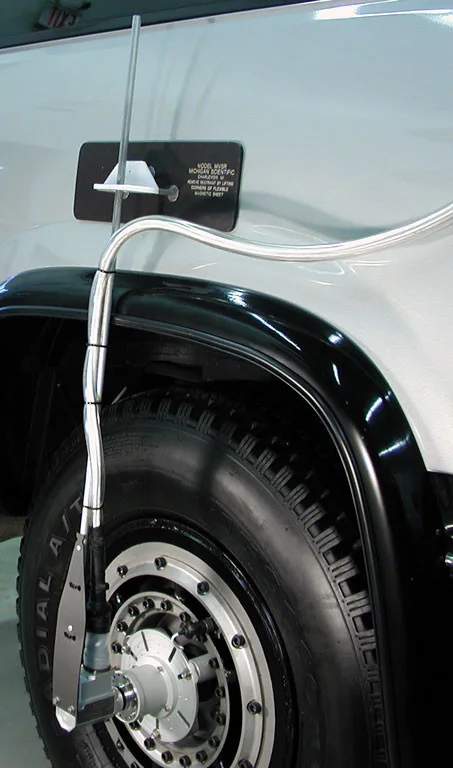
In brief
Brake disc temperature is measured while driving with thermocouples fixed to the disc and the hub. The sensors turn with the wheel, so their signals leave it through a slip ring or a telemetry package bolted to the vehicle's own wheel. A thermocouple amplifier on the rotating side adds the cold junction compensation and sends a high-level voltage through the contacts. The test runs on the road, on the track or on the bench.
- 4 to 36
- circuits on the Wheel Instrumentation System slip ring
- 2 000 rpm
- maximum speed of the Wheel Instrumentation System
- Up to 9
- thermocouples amplified by one AMP-TCN-X2 module
Why brake temperature is read on the vehicle
Brake testing has to quantify the heat each stop generates. That heat appears in the parts that turn: the disc, the hub and the wheel.
Measuring on the vehicle gives the temperature of these parts during real stops, with the vehicle's own wheels and brakes. The Wheel Instrumentation System fits passenger cars, utility vehicles, heavy trucks and agricultural vehicles.
The thermocouple turns with the wheel
A thermocouple fixed to a disc turns with it, and its wires cannot go straight to a recorder in the cabin. Something has to carry the signal from the rotating side to the stationary side.
A slip ring does this with an electrical connection between a rotating component and a stationary one. A telemetry package does it by radio, with no contact. Both mount outboard on the wheel.
From the disc to the recorder, in four steps
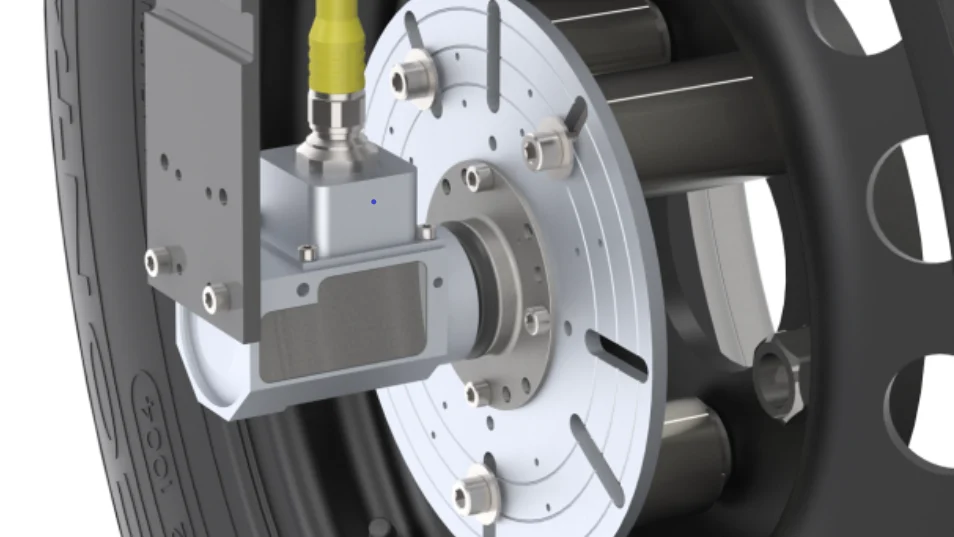
The package bolts onto the original wheel through a plate and collet lug nuts machined for the vehicle. Nothing on the vehicle is modified.
- 01
Fix the thermocouples to the disc and the hub
The thermocouples are attached to the spinning parts at the points to monitor, and their wires are routed to the outside of the wheel.
- 02
Bolt the package to the vehicle's own wheel
The Wheel Instrumentation System mounts on the original wheel with its plate and collet lug nuts. It is waterproof and works in mud and snow.
Wheel Instrumentation System - 03
Connect directly, or through an amplifier
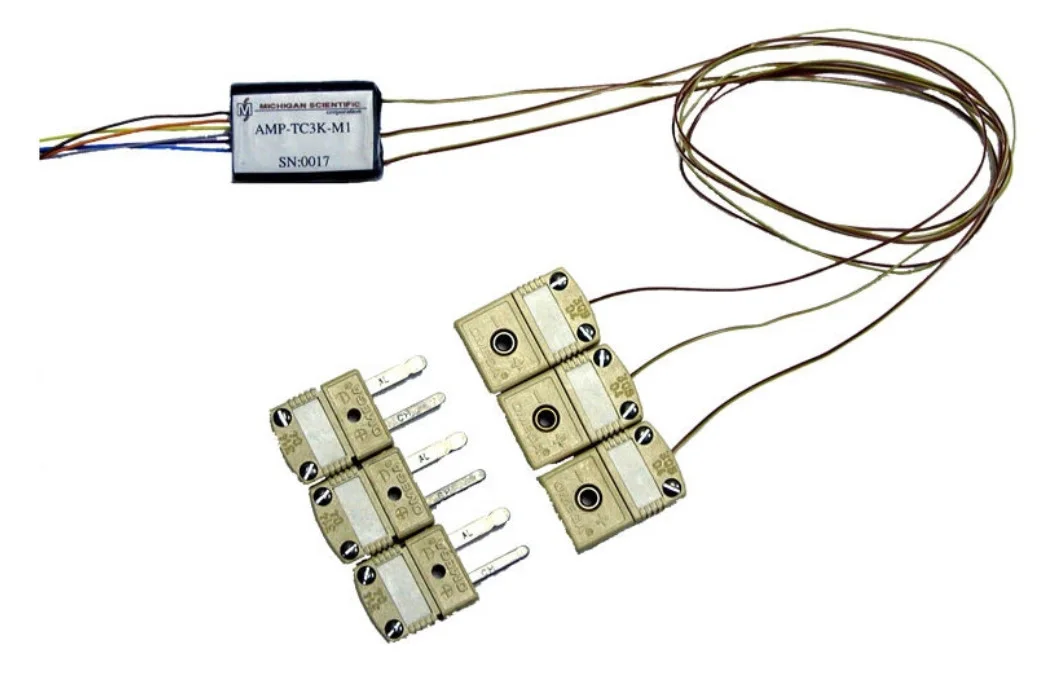
The slip ring has a low resistance and is designed for low-voltage signals such as thermocouples, so the thermocouple wires can go straight to it. An amplifier on the rotating side adds the cold junction compensation and sends a high-level voltage through the rings.
AMP-TC-M1 thermocouple amplifier - 04
Record temperature with wheel speed
The stator cable goes to the data acquisition system. An optional encoder, up to 1 024 pulses per revolution, adds wheel speed and distance on the same assembly.
Slip ring or telemetry wheel package
The Wheel Instrumentation System carries the signals in analog form through 4, 6, 10, 20 or 36 circuits. Up to 30 measurements can be collected at the same time, so thermocouples and strain gages can share the same wheel. It runs up to 2 000 rpm.
The telemetry wheel package sends strain gage and thermocouple signals by radio, brake rotor temperature among them. It runs on a single 9 V battery, fits most wheel sizes and has a removable cover.
Michigan Scientific telemetry systems use a digital 2.4 GHz link with a range of up to four metres line of sight.
Amplifying the thermocouples before the contacts
The rings and brushes of a slip ring are not made of thermocouple alloys. A temperature difference between its rotor and stator connections therefore adds an error at those dissimilar-metal contacts. An amplifier on the rotating side holds the cold junction compensation and sends a high-level voltage through the slip ring, which the gradient cannot affect.
The AMP-TC-M1 takes one to three thermocouples of type E, J, K or T. It is adhered, potted or strapped to the part and gives a 0 to 10 V DC output. The MicroTC takes one type K thermocouple, weighs 3.9 g and gives a linear 5 mV per °C from −25 to 400 °C.
On an SR Series end-of-shaft slip ring, the AMP-TCN-X2 mounts on the rotor and amplifies up to nine thermocouples per module, with an output of 10 mV per °C. The modules stack for more channels.
What you get
The temperature of the disc and the hub during the stop, recorded on the vehicle's own wheel, with wheel speed if the encoder is fitted. The signal path is chosen for the test: a slip ring for many channels, a telemetry package for a link with no contact, and an amplifier on the rotating side for cold junction compensation and a high-level signal through the rings.
Frequent questions
Can a thermocouple be wired straight through a wheel slip ring?
Yes. The slip ring of the Wheel Instrumentation System has a low resistance and is designed for low-voltage signals such as thermocouples. Its rings and brushes are not thermocouple alloys, so a temperature gradient across them adds an error at those contacts. An amplifier on the rotating side sends a high-level voltage instead, which the gradient cannot affect.
Does the wheel have to be changed to measure brake temperature?
No. The Wheel Instrumentation System mounts on the original wheel of the vehicle through a plate and collet lug nuts machined for that vehicle.
Can brake disc temperature be measured without a slip ring?
Yes. A telemetry wheel package sends thermocouple signals from the wheel by radio. It is powered by a single 9 V battery and fits most wheel sizes.
Which thermocouple types do the rotating amplifiers accept?
The AMP-TC-M1 and the AMP-TCN-X2 are ordered for type E, J, K or T thermocouples. The MicroTC is made for type K only.
Similar applications
All applications-
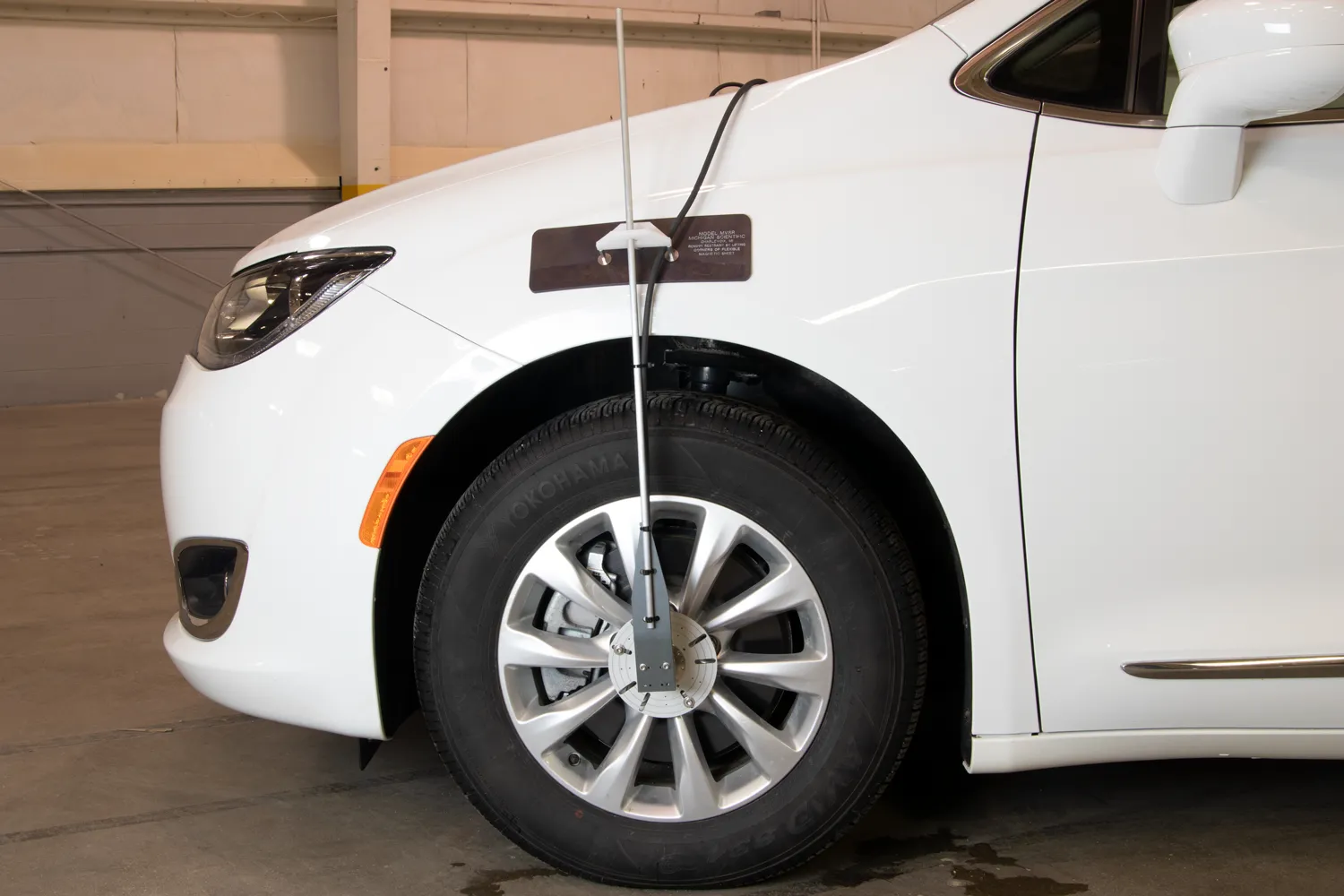 Temperature Temperature on rotating parts The temperature of a bearing, a compressor or a brake rotor, read while the part rotates under load.
 -
 Brakes Brake pedal force The force the driver puts on the brake pedal, read up to 2 200 N on the series pedal.
 -
 Electric Temperature in electric vehicles Temperatures on the rotating parts of an electric motor, brought out by a slip ring with amplifiers in its rotor.