Application · Electric
Measuring temperature on the rotating parts of an electric vehicle motor
In brief
Heat produced in a conductor is power lost, and temperature limits how powerful an electric motor can be. Thermocouples are placed on the rotating parts of the motor. An end-of-shaft slip ring with thermocouple amplifiers in its rotor brings the signals to the recorder. Michigan Scientific built such a unit for an electric vehicle test. Its design shows what to plan for.
- 20 000 rpm
- speed rating of the slip ring built for the project
- 14
- solder terminals for Type T thermocouples
- 125 °C
- heat tolerated by the standard amplifiers
Heat is lost power
Joule's law says that the heat given off each second in a circuit equals the power lost in it. The more current flows in the conductors, the more heat they produce. Temperature is therefore a major limit when more powerful electric motors are designed, and high temperatures can also shorten the life of a battery.
Measuring temperature shows where energy leaves the system as heat, and controlling it is one of the ways to improve the efficiency of the whole vehicle.
Speed, vibration and heat at the same place
The parts of interest rotate, so the thermocouple signals have to cross from the rotating side to the recorder. The instrumentation sits in a place that is hot, vibrates and leaves little room. A thermocouple gives a millivolt-level signal, and the rings and brushes of a slip ring are not made of thermocouple alloys: a temperature gradient across them adds an error at those dissimilar-metal contacts.
Thermocouples, amplifiers in the rotor, a slip ring on the shaft end
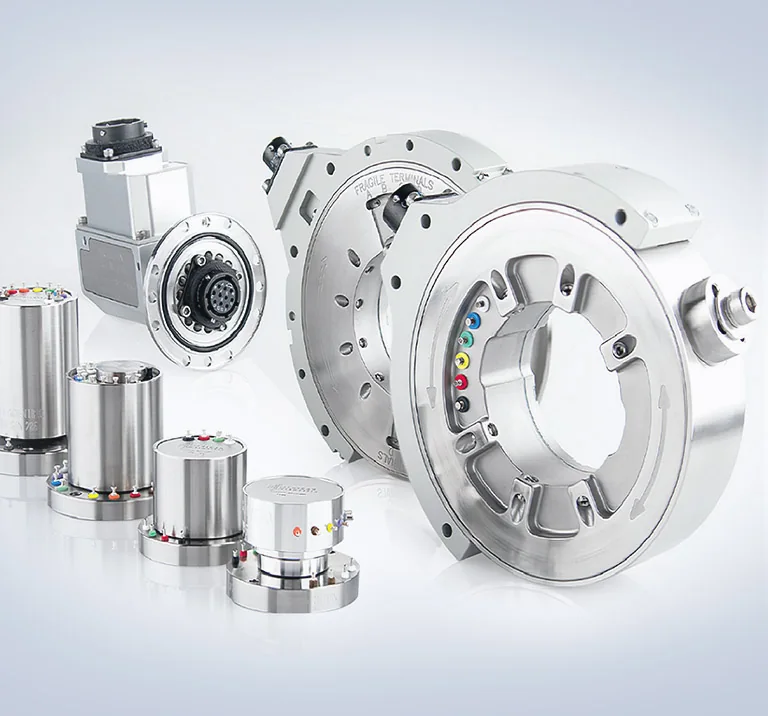
For this project, Michigan Scientific designed an end-of-shaft slip ring assembly: a unit that mounts on the end of the rotating shaft and connects to the data acquisition system. Several Type T thermocouple amplifiers were built into its rotor. Because the unit was small and the amplifiers were integrated, it could fit inside most vehicles.
- 01
Place the thermocouples
Thermocouples are fitted to the rotating parts whose temperature is needed.
- 02
Amplify on the rotating side
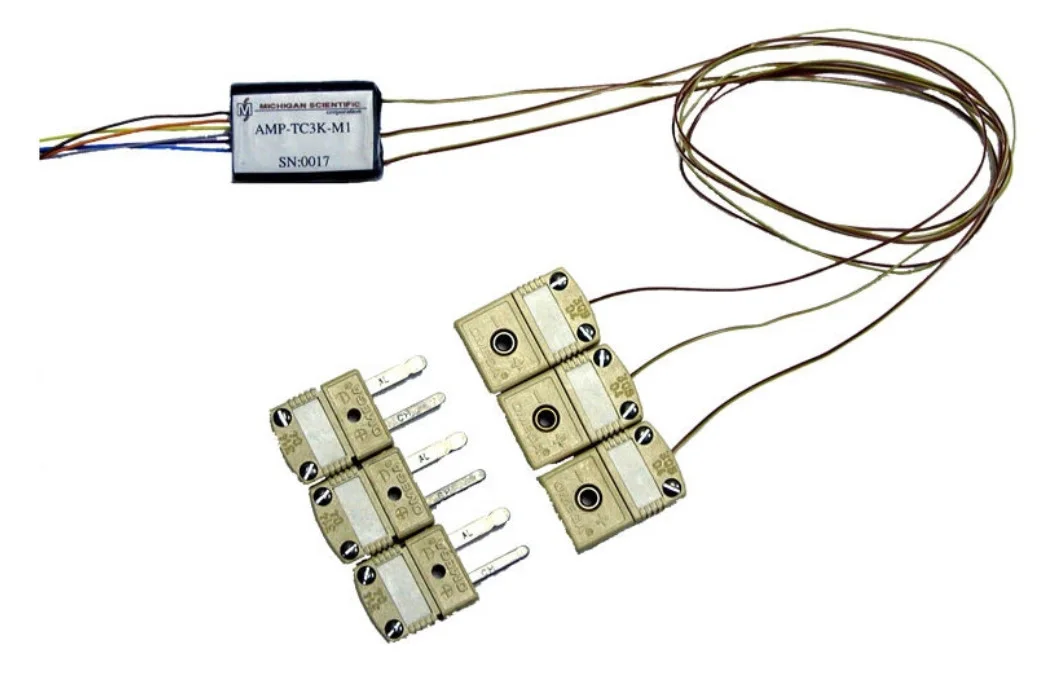
The thermocouples are wired to amplifiers in the rotor of the slip ring. Each amplifier holds the cold junction compensation and sends a high-level voltage through the rings, which the temperature gradient cannot affect. The project unit had 14 solder terminals for Type T thermocouples and 2 more for the amplifier circuit common.
AMP-TC-M1 thermocouple amplifier - 03
Cross the slip ring
The amplified signals pass through the slip ring to the recorder. The project unit had ten slip ring connections and a speed rating of 20 000 rpm.
S-Series end-of-shaft slip rings - 04
Harden the connections
The internal slip ring connections were modified to withstand the high vibration and temperature at the motor.
Above 125 °C, a thermal break
Standard Michigan Scientific signal conditioning amplifiers tolerate heat up to 125 °C (257 °F). For hotter tests, a thermal break adapter can be added. It is made to fit the diameter of a slip ring stator with an integrated amplifier, and it lowers the heat that reaches the amplifier in places where space is tight.
Telemetry where a slip ring cannot go
Wireless telemetry is the other way to bring thermocouple signals off a rotating part. Michigan Scientific telemetry systems are used for component analysis in hard-to-reach areas of the motor or the powertrain, including transmissions and compressors.
The electrical activity of an electric vehicle makes a wireless link harder to shield from noise. Michigan Scientific has developed ways of instrumenting electric vehicles that reduce the effect of this noise.
What you get
Temperatures measured on the rotating parts of the motor, with the amplifiers close to the thermocouples. The data shows where power is lost as heat, which helps to improve the efficiency of the vehicle.
Frequent questions
How fast can a slip ring turn on an electric motor shaft?
The end-of-shaft slip ring that Michigan Scientific built for an electric vehicle test had a speed rating of 20 000 rpm.
What temperature can the amplifiers in a slip ring withstand?
Standard Michigan Scientific signal conditioning amplifiers tolerate heat up to 125 °C (257 °F). For hotter tests, a thermal break adapter lowers the heat that reaches the amplifier.
Which thermocouples were used on the electric motor project?
Type T thermocouples. The slip ring had 14 solder terminals for them, 2 more for the amplifier circuit common, and ten slip ring connections.
Can telemetry measure motor temperature in place of a slip ring?
Yes. Wireless telemetry also brings thermocouple signals off a rotating part. It is used in hard-to-reach areas of the motor or the powertrain, including transmissions and compressors.