
Application · Powertrain
Taking signals off a drive shaft that has no free end
In brief
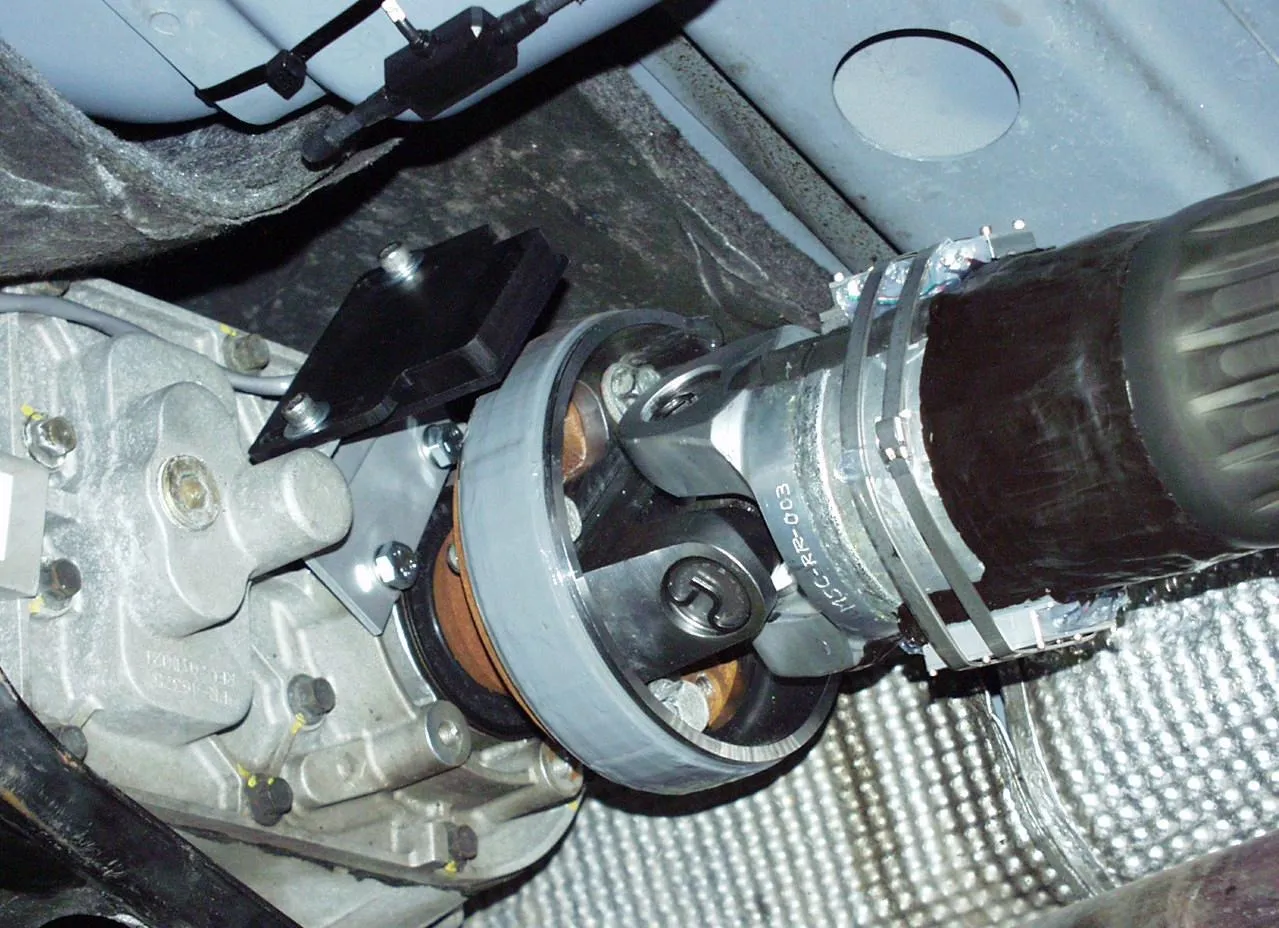
An end-of-shaft slip ring needs an open end on the shaft. A drive shaft in a vehicle does not have one. A tubular slip ring has a through bore: it mounts directly on the shaft, in the space available along its length, and passes the sensor signals to the data acquisition system.
- 30 to 81 mm
- shaft diameters covered (1.2 to 3.2 in)
- 4 to 8
- slip ring connections
- 7 000 rpm
- rating of the B4-2 and B6-2, for shafts up to 51 mm (2 in)
When the shaft has no free end
In a vehicle test, the drive shaft, or prop shaft, is coupled at both ends. Neither end is free to take an end-of-shaft slip ring. The middle of the shaft is accessible.
A slip ring that slides over the shaft
A tubular slip ring works on the same principle as an end-of-shaft one, a ring and brush interface. The shaft passes through the rotor, which is secured to it with set screws and turns with it. The brushes pass the signals to the stationary side. Rings and brushes are in precious metals, for the low-level signals of strain gauges and thermocouples; accelerometers and other sensors connect the same way.
Drive shaft testing is one of the most common uses: torque, strain or temperature from sensors on the shaft. An encoder package is optional on all models, to monitor the rotation of the shaft; the /E60 versions carry a 60 ppr encoder.
Sealed for the road
The weatherproof models are sealed against water spray, grit, dust, mud, slush and snow, which keeps contamination and corrosion away from the rings and brushes. Field tests run in real driving conditions, so the slip ring is exposed to all of these.
Amplify on the rotating side
On an exposed drive shaft, a temperature gradient across the slip ring contacts can enter a low-level signal. With a thermocouple, rings and brushes are not made of thermocouple alloys, so a temperature difference between rotor and stator adds an error at those dissimilar-metal contacts. The assemblies are available with amplifiers on the rotating side, close to the sensor, which send a high-level voltage through the rings.
- Less error from long lead wires
- Less error from connector resistance variations
- Less electromagnetic interference
- Less effect of temperature gradients
What you get
Torque, strain or temperature from the shaft itself while the vehicle is driven, with the shaft rotation if you add the encoder, through a slip ring sealed for the weather.
Frequent questions
What shaft diameters does a tubular slip ring fit?
Tubular slip rings cover shaft diameters from 30 to 81 mm (1.2 to 3.2 in). The B4-2 and B6-2, for shafts up to 51 mm (2 in), are rated at 7 000 rpm.
Can a slip ring be used on a drive shaft in rain and mud?
Yes. The weatherproof tubular slip rings are sealed against water spray, grit, dust, mud, slush and snow.
Why put the amplifier on the rotating side of the slip ring?
On an exposed drive shaft, temperature gradients across the slip ring contacts can cause signal errors. An amplifier on the rotating side, close to the sensor, reduces these errors and those from long lead wires, connector resistance and electromagnetic interference.
Can shaft speed be measured with the same slip ring?
Yes. An encoder package is optional on all tubular slip ring models, to monitor the rotation of the shaft.
Similar applications
All applications-
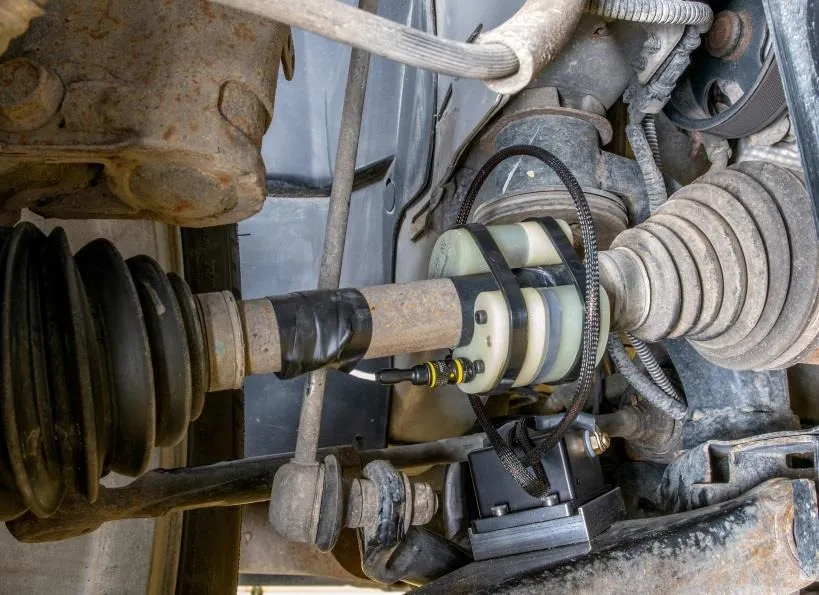 Powertrain Axle and half-shaft torque Drive torque measured on the production shaft, with a slip ring or telemetry to bring the signal out.
 -
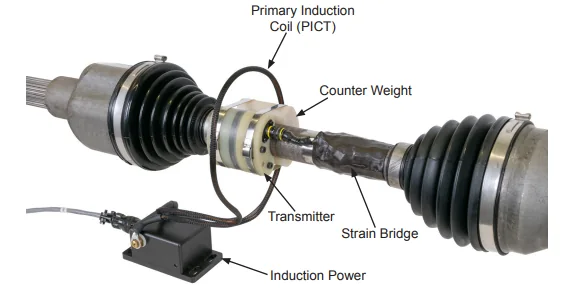 Electric EV powertrain torque Torque at each stage of the electric drivetrain, from gearbox shafts to the wheel, to see where power is lost.
 -
 Efficiency Vehicle efficiency and power mapping Torque and speed measured at each driveline stage, from engine to wheel, so each power loss has a location.