
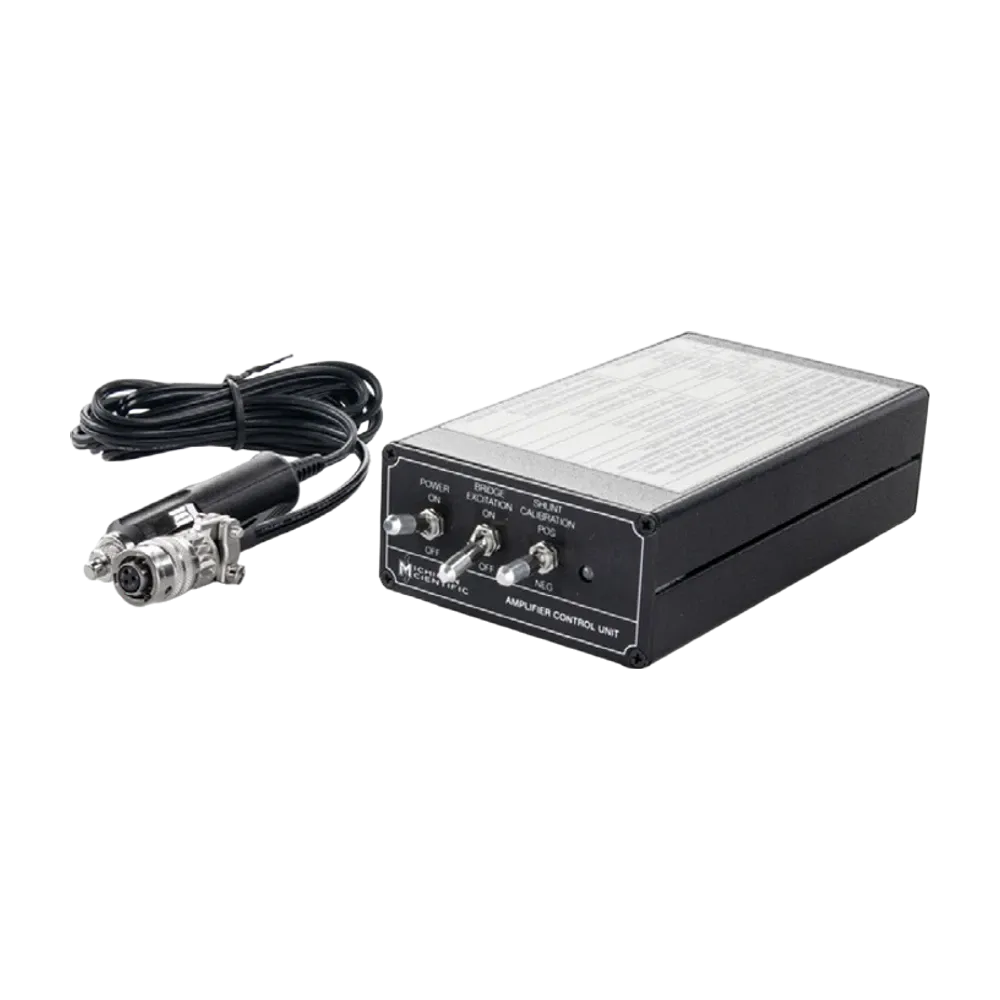
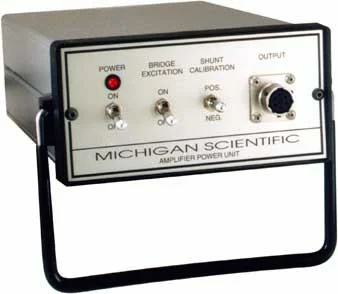
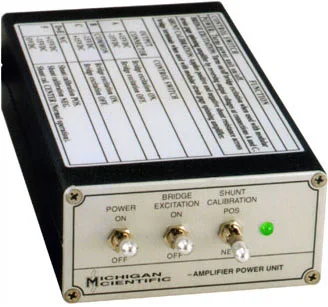
PS-DC and PS-AC remote amplifier control units
Remote amplifier control units that power Michigan Scientific spinning amplifiers with ± 15 V and switch bridge excitation and shunt calibration remotely: the PS-DC on 10 to 36 V DC for up to 22 amplifiers, the PS-AC on AC mains for up to 18.
- up to 22
- Spinning strain gage amplifiers
- ± 15 V
- Output voltage
- 1 A
- Maximum current
- 10 to 36 V DC
- Input voltage
- up to 18
- Spinning strain gage amplifiers
- ± 15 V
- Output voltage
- 0.8 A
- Maximum current
- 100–120 or 220–240 V AC
- Input voltage
- ModelsPS-DC · PS-AC
- Output connectorPT02E-10-6S, 6-pin female
- Operating temperature−25 to 70 °C
- Useautomotive (PS-DC) · laboratory (PS-AC)
- ModelsPS-DC · PS-AC
- Output connectorPT02E-10-6S, 6-pin female
- Operating temperature0 to 50 °C
- Useautomotive (PS-DC) · laboratory (PS-AC)
Power, excitation and shunt calibration
The PS-DC and the PS-AC control Michigan Scientific spinning amplifiers. They power them with a bipolar ± 15 V supply, control the excitation of the strain gage bridges and command the amplifiers to apply their internal shunt calibration resistor to the appropriate arm of the bridge.
The PS-DC runs on 10 to 36 V DC, which suits automotive applications: it controls up to 22 spinning strain gage amplifiers, delivers up to 1 A and operates from −25 to 70 °C. The PS-AC runs on 100 to 120 V AC or 220 to 240 V AC at 50/60 Hz and is intended for the laboratory: it powers up to 18 strain gage amplifiers at 5 V bridge excitation on 350 Ω bridges, delivers up to 0.8 A and operates from 0 to 50 °C.
The amplifiers connect to the six-pin female PT02E-10-6S output connector, supplied with its mating connector on new units: ± 15 V, common, ground and calibration control. The PS-DC takes its supply on a three-pin male PT02E-8-3P connector. The power switch turns the unit on and lights the LED; on the PS-DC, the LED turns red on over-current, shunt calibration or bridge excitation off. The bridge excitation switch inverts the polarity of the ± 15 V pins, which turns the bridge excitation off without turning the amplifiers off. The shunt calibration switch puts + 15 V, high impedance or − 15 V on the calibration line, for positive or negative shunt calibration.
With bridge excitation off, what remains on the output is the noise the system picks up from undesired environmental conditions.
Specifications
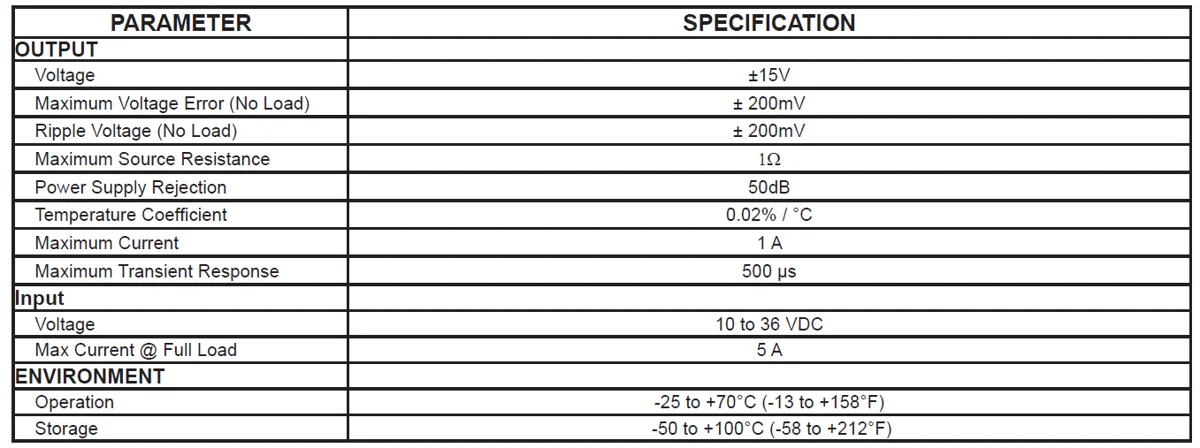
| Output range | −15 to 15 V (± 200 mV max error at no load; ± 200 mV ripple at no load; 0.02 %/°C; power supply rejection 50 dB; bridge on/off switch inverts the polarity) |
|---|---|
| Shunt calibration | Positive · Negative · Manual switch (positive / center / negative switch) |
| Output current | 1 A (source resistance 1 Ω max; transient response 500 µs max) |
| Supply voltage | 10 to 36 V (DC; 5 A max at full load; power-on LED, red on over-current, shunt calibration or bridge excitation off) |
| Amplifiers powered | 22 (spinning strain gage amplifiers) |
| Operating temperature | −25 to 70 °C |
| Storage temperature | −50 to 100 °C |
| Connections | Connector (input: 3-pin male PT02E-8-3P; output: 6-pin female PT02E-10-6S; mating connectors supplied with new units) |
| Connector | PT02E-10-6S |
| Function | Remote amplifier control unit (DC powered) |
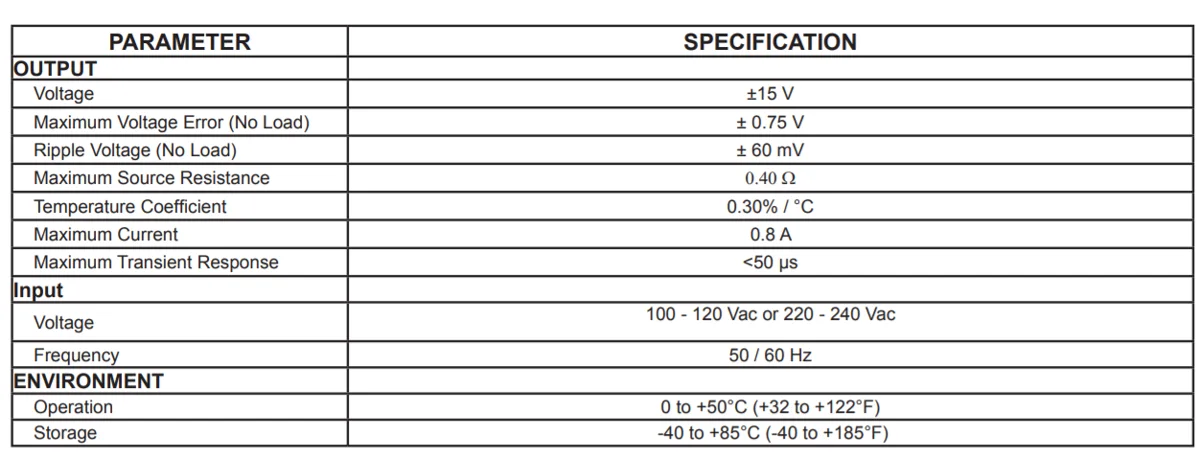
| Output range | −15 to 15 V (± 0.75 V max error at no load; ± 60 mV ripple at no load; 0.30 %/°C; bridge on/off switch inverts the polarity) |
|---|---|
| Shunt calibration | Positive · Negative · Manual switch (positive / center / negative switch) |
| Output current | 800 mA (source resistance 0.40 Ω max; transient response < 50 µs) |
| Supply voltage | 100 to 240 V (100 to 120 V AC or 220 to 240 V AC; 50/60 Hz; power-on LED) |
| Amplifiers powered | 18 (spinning strain gage amplifiers, 5 V bridge excitation, 350 Ω bridges) |
| Operating temperature | 0 to 50 °C |
| Storage temperature | −40 to 85 °C |
| Connections | Connector (6-pin female PT02E-10-6S, mating connector supplied with new units) |
| Connector | PT02E-10-6S |
| Function | Remote amplifier control unit (AC powered) |
Request a quote
Resources
Datasheets and manuals
Drawings
None for this product.
CAD models
None for this product.
A question on this product?
Describe the measurement. An application engineer answers.
More details to give? Use the full contact form.